
CITES & CoP20 Summit
11.12.2025
CITES & CoP20 Summit
Context
Marking a significant milestone in global conservation, the Convention on International Trade in Endangered Species of Wild Fauna and Flora (CITES) celebrated its 50th anniversary during the CoP20 summit in Samarkand, Uzbekistan. The conference focused on species protection, sustainable livelihoods, and governance of the wildlife trade.
About 50 Years of CITES Definition:
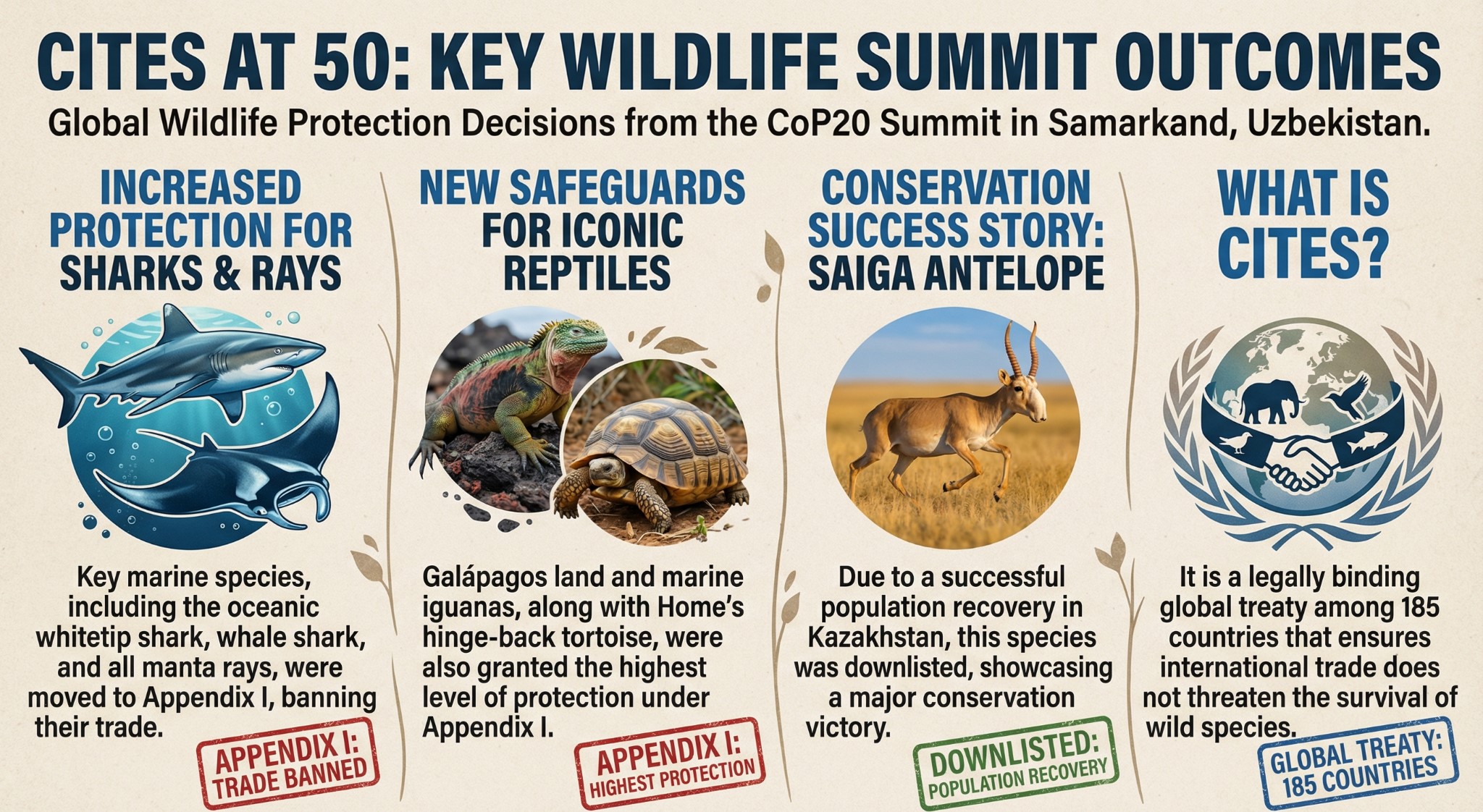
- CITES is a legally binding multilateral treaty dedicated to ensuring that the international trade of wild animals and plants does not threaten their survival.
History & Timeline:
- Origins: Conceptualized by the IUCN in 1963.
- Finalisation: The text was finalized in Washington D.C. in 1973.
- Enforcement: Officially entered into force on July 1, 1975.
- Global Reach: currently has 185 Parties (as of 2025), ranking it among the largest conservation agreements globally.
Core Mechanism:
- Operates through a system of permits and certificates regulated by three distinct Appendices (I, II, and III), which classify species based on their risk of extinction.
Key Functions:
- Regulation: Controls cross-border wildlife trade through strict documentation.
- Protection: Assigns protection levels to species corresponding to their biological status.
- Enforcement & Cooperation: Coordinates global efforts to combat illegal wildlife trafficking and promotes scientific assessment for sustainable usage.
About 2025 CITES Summit (CoP20) Overview:
- The 20th Conference of the Parties (CoP20) is the supreme decision-making body of the convention, convening every 2–3 years to shape global policy.
Host & Significance:
- Location: Samarkand, Uzbekistan.
- Milestone: This was the first CoP held in Central Asia, coinciding with the treaty's 50th anniversary.
Major Outcomes Species Additions & Uplisting (Increased Protection):
- Total Additions: 77 new species were added to the CITES Appendices.
- Marine Life: Several sharks and rays, including the oceanic whitetip, whale shark, and all species of manta and devil rays, were moved to Appendix I (trade banned).
- Reptiles: Galápagos land iguanas (3 species), marine iguanas, and African reptiles like Home’s hinge-back tortoise were uplisted to Appendix I.
Conservation Successes (Downlisting):
- Saiga Antelope: Reflecting successful conservation in Kazakhstan, this species was removed from Appendix II, allowing for flexible export regulations.
- Guadalupe Fur Seal: Native to Mexico, this species was moved from Appendix I to Appendix II due to population recovery.
India’s Role Diplomatic Stance:
- India successfully blocked the European Union's proposal to list Guggul (Commiphora wightii) in Appendix II.
- Reasoning: India argued there was a lack of sufficient scientific assessment to warrant the listing at this stage.
Conclusion
The CoP20 summit reaffirmed the global commitment to biodiversity. By balancing strict protection for threatened species (like sharks) with the recognition of conservation successes (like the Saiga antelope), CITES continues to evolve as a dynamic tool for sustainable development and wildlife preservation.