
Education Cost in India
12.12.2025
Education Cost in India
Context
Rising unaffordability of education in India and the widening divide it creates between rich and poor households. Education, though a fundamental right, is increasingly becoming a costly commodity rather than an accessible public good.
Constitutional and Policy Background
Article 21A:
Guarantees the Right to Free and Compulsory Education for all children aged 6–14 years, operationalized through the RTE Act, 2009.
NEP 2020:
Seeks universalisation of education from ages 3 to 18 by 2030, focusing on Access, Equity, Quality, Affordability, and Accountability.
Current Scenario and Statistics
Enrollment Trends (National Average)
• Government Schools: 55.9% (dominant in rural India)
• Private Unaided Schools: 31.9% (dominant in urban areas)
• Private Aided Schools: 11.3%
Urban–Rural Divide
Urban households prefer private schools, while rural families rely primarily on government schools.
Gender Gap
Parents choose private schools more often for boys (34%) than for girls (29%), reflecting socio-cultural biases.
Dropout and Shifts
In Classes 11–12, many students migrate from costly private schools to government schools as annual fees of ₹20,000–₹50,000 become unsustainable.
The Cost Crisis (The "Double Burden")
The financial burden on households has created a clear cost gradient:
School Type (Annual Avg. Household Expenditure) |
Rural (₹) |
Urban (₹) |
Difference (Rural → Urban Private Unaided) |
Government Schools |
2,801$ |
4,374$ |
Almost 8-fold Increase |
Private Unaided Schools |
22,919$ |
35,798$ |
|
Fee Disparity
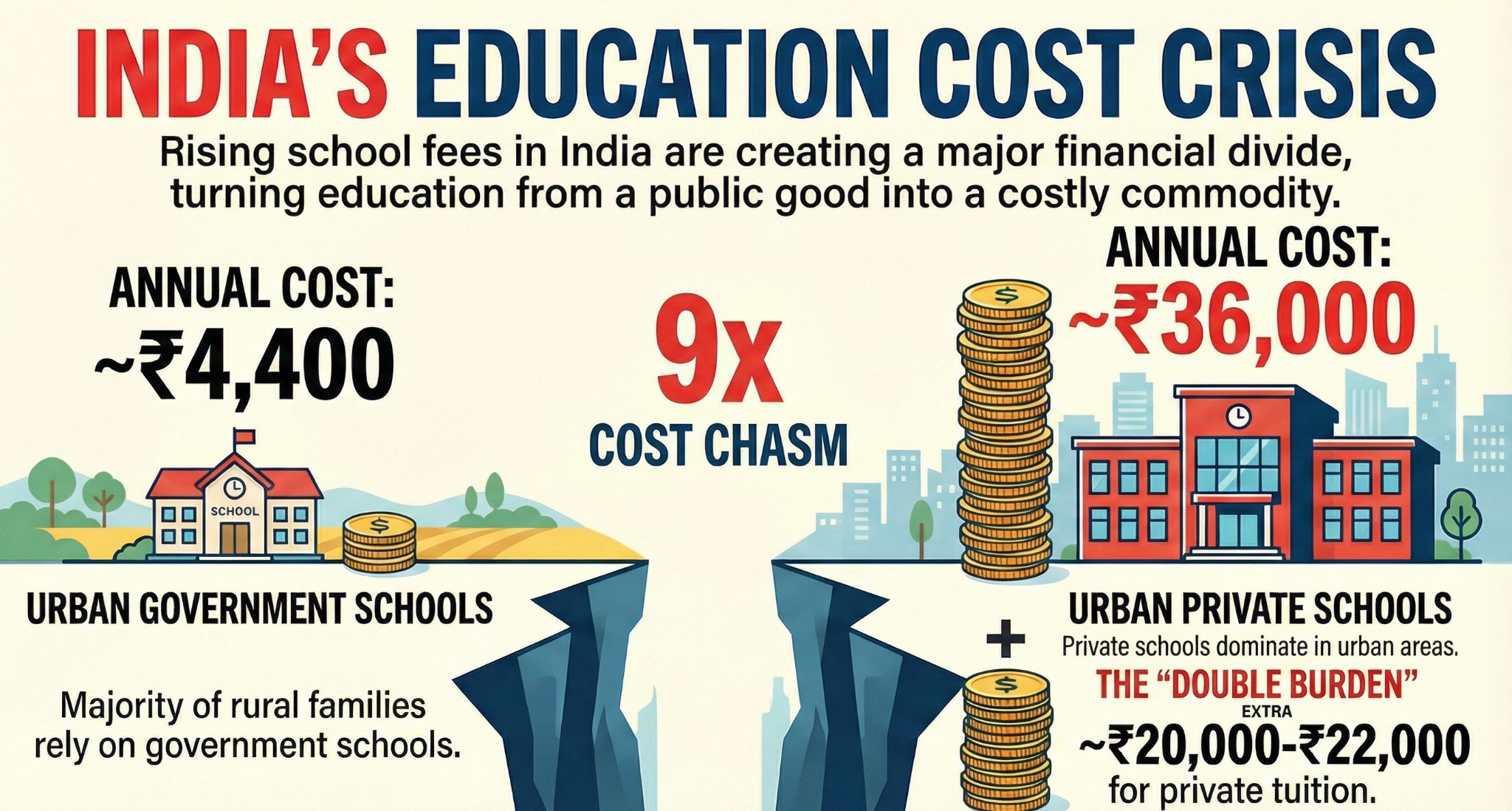
Urban private unaided schools (~₹36,000 annually) cost almost nine times more than government schools (~₹4,400). This widens inequality and strains the budgets of lower- and middle-income families.
Private Tuitions: The Second Burden
Despite high private school fees, many students take additional coaching due to:
• Poor classroom teaching quality
• Fear of exam underperformance
• Competitive exam pressure
Tuition expenses in Classes 11–12 often reach ₹20,000–₹22,000 annually, creating a non-negotiable financial load.
Result: Education is increasingly treated as a purchased service, excluding disadvantaged groups and reducing upward social mobility.
Way Forward
1. Strengthen Government Schools
• Increase public spending to meet the 6% of GDP benchmark
• Upgrade infrastructure, teacher training, and monitoring
• Make government schools the preferred choice for quality education
2. Strict Regulation of Private School Fees
• Enforce state Fee Regulation Acts
• Prevent arbitrary fee hikes and unjustified charges
3. Expand Targeted Scholarships
• Strengthen delivery of scholarships for SC/ST/OBC/EWS
• Offset the twin burden of school fees and tuitions
4. Reduce Dependence on Private Tuitions
• Reform assessments per NEP 2020
• Enforce bans on teachers offering private tuitions
• Improve in-school academic support
Conclusion
The escalating cost of schooling, compounded by widespread dependence on private tuitions, erodes the constitutional guarantee of free and compulsory education under Article 21A. The vision of NEP 2020 is universal, equitable, and high-quality education which requires robust public investment, systemic reforms, and strict regulation of private institutions. Ensuring that education remains accessible and affordable, rather than aspirational and exclusive, is essential for strengthening social justice and enabling true economic mobility in India.