
Generative AI & Copyright
12.12.2025
Generative AI & Copyright
Context
The Government released the Working Paper on Generative AI & Copyright – One Nation, One License, One Payment, proposing India’s first structured model for regulating AI training on copyrighted works. It aims to balance creator rights and AI innovation, following rising disputes like ANI vs OpenAI (Delhi HC, 2024–25) over unauthorized training on Indian content.
About Generative AI & Copyright – One Nation, One License, One Payment
What is the Issue?
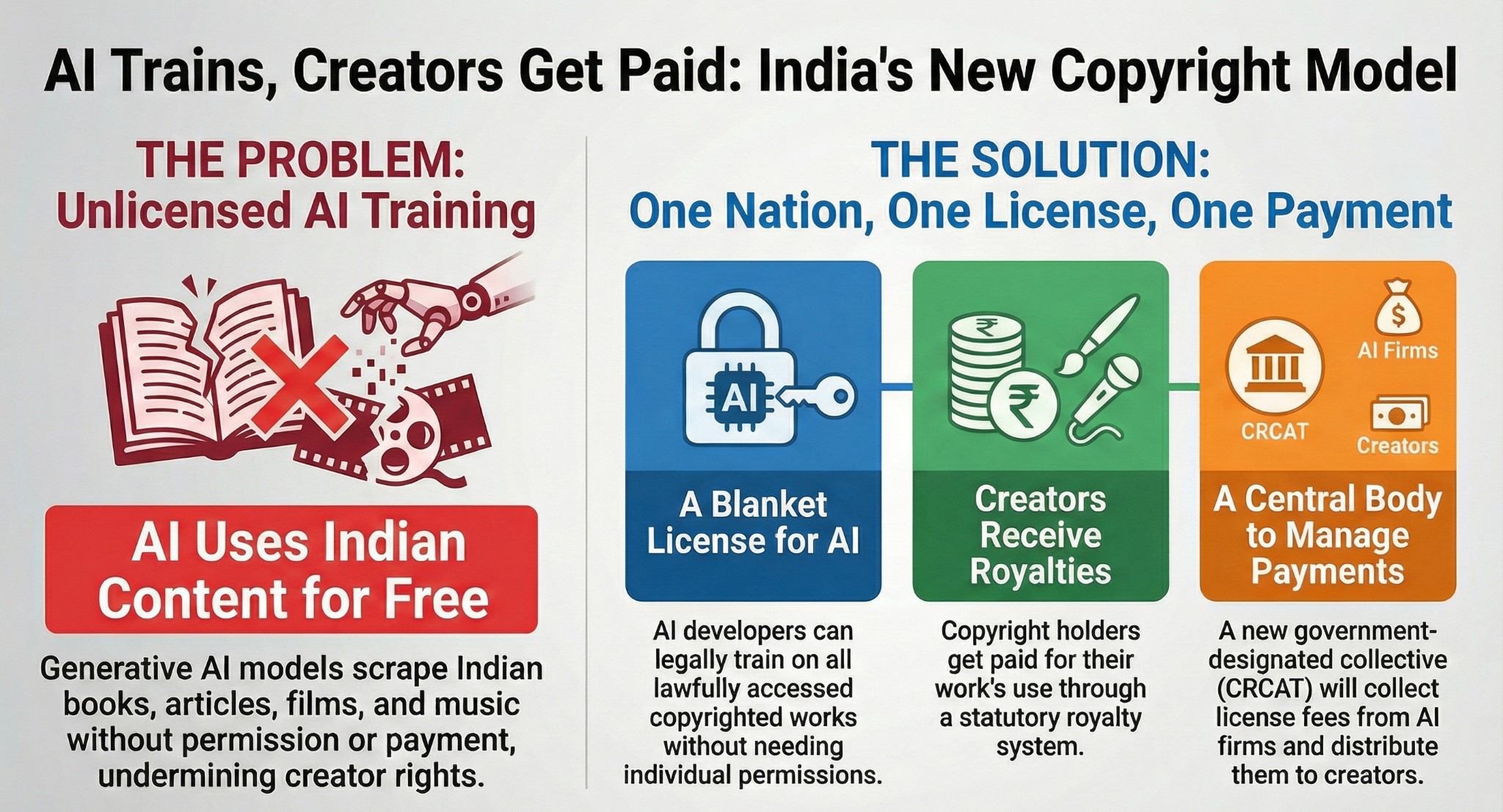
- Unlicensed use of Indian creative content for AI training: GenAI models scrape Indian books, articles, films, music, and news without permission, undermining creator rights and violating Section 14 protections.
- Eg: ANI alleged OpenAI used its news content for training ChatGPT without consent, triggering Delhi HC proceedings.
- Lack of clarity on applicability of copyright law to GenAI training: India’s Copyright Act has no explicit Text & Data Mining (TDM) exception, creating ambiguity on whether large-scale scraping is permissible.
- Eg: Section 52 exceptions do not cover commercial AI training, leaving foreign AI developers operating in a legal grey zone.
- No mechanism for creators to receive compensation from AI usage: Indian writers, artists, musicians, and journalists gain nothing even though their works significantly improve AI model accuracy and quality.
- Eg: India’s informal music industry employing 1.4 crore people earns zero royalties despite models using their songs for training.
- Risk of cultural dilution & decline of indigenous creative sectors: AI outputs may replace or overshadow Indian folk art, local music, and regional storytelling traditions, eroding cultural diversity.
- Unequal bargaining power between big-tech AI firms and Indian creators: Large foreign AI companies monetise Indian datasets while individual creators lack negotiation capacity or legal tools to protect rights.
Key Concerns Identified by the Working Group
- Whether AI training constitutes reproduction and thus copyright infringement: AI training requires copying, storing, and transforming large volumes of works, which may trigger infringement under Section 14.
- Whether the ‘fair dealing’ exception can legally cover GenAI training: Fair dealing is narrowly defined for private research, criticism, or reporting—not for commercial AI model training at an industrial scale.
- Eg: Commercial LLM developers cannot invoke Section 52(1)(a), as training is revenue-driven and not "personal use".
- Disadvantage & exploitation risk for small and independent creators: Opt-out or negotiated licensing frameworks disproportionately favour big publishers, leaving small creators unprotected.
- Heavy transparency burden on AI developers if disclosure is mandated: Requiring detailed dataset disclosures could slow AI advancement, especially for start-ups lacking compliance capacity.
- Threat of poor-quality or biased datasets if creators withhold works: Excessive opt-outs may shrink datasets, increasing bias and hallucination risks in India-focused AI systems.
Need for India to Balance Copyright & AI Framework
- Protect India’s rapidly growing creative and cultural economy: Creative industries contribute billions to GDP and sustain livelihoods across entertainment, design, folk, and digital media sectors.
- Foster AI innovation aligned with IndiaAI Mission goals: Balanced rules ensure that AI developers, especially Indian start-ups which have predictable, lawful access to high-quality datasets.
- Prevent decline of human creativity and preserve cultural diversity: If AI freely mines creative works without reward, long-term incentives for creators weaken, risking cultural hollowing.
- Ensure fair revenue-sharing for Indian creators whose works train AI: AI firms earn from Indian users; creators deserve statutory royalties to maintain creative ecosystems.
- Support Indian startups & MSMEs with low-cost, low-friction AI licensing: A predictable licensing regime reduces transaction costs and enables small players to innovate without legal uncertainty.
Recommendations of the Working Committee
- Introduce a Mandatory Blanket License for AI Training: AI developers may train on all lawfully accessed copyrighted works without individual permissions, ensuring wide dataset access.
- Eg: Indian LLMs (Sarvam, Gan AI, Soket) can legally train on diverse Indian content across languages and formats.
- Statutory Royalty Payments to Copyright Holders: Creators will receive compensation proportional to AI revenues, ensuring long-term sustenance of the creative economy.
- Establish the “Copyright Royalties Collective for AI Training (CRCAT)": A central, government-designated body to collect licence fees and distribute royalties to members and non-members alike.
- Create a Government-Appointed Royalty Rate-Setting Committee: Ensures transparency, fairness, periodic review, and judicial oversight of royalty rates to protect both creators and developers.
- Provide a Single-Window, Low-Burden Licensing & Compliance System: One licence $\to$ one payment $\to$ nationwide applicability to reduce friction, especially for smaller AI players.
Conclusion
India stands at a critical intersection where AI growth and creative rights must advance together. The “One Nation, One License, One Payment” model proposes a fair, innovation-friendly, creator-protective solution. If adopted, it can make India a global leader by building an AI ecosystem rooted in fairness, cultural respect, and technological strength.