
Hindu Rate of Growth
09.12.2025
Hindu Rate of Growth
Context
The Prime Minister recently criticized the phrase "Hindu rate of growth," labeling it as a colonial and communal tag that unfairly associates India’s past economic
About Hindu Rate of Growth Definition and Origin:
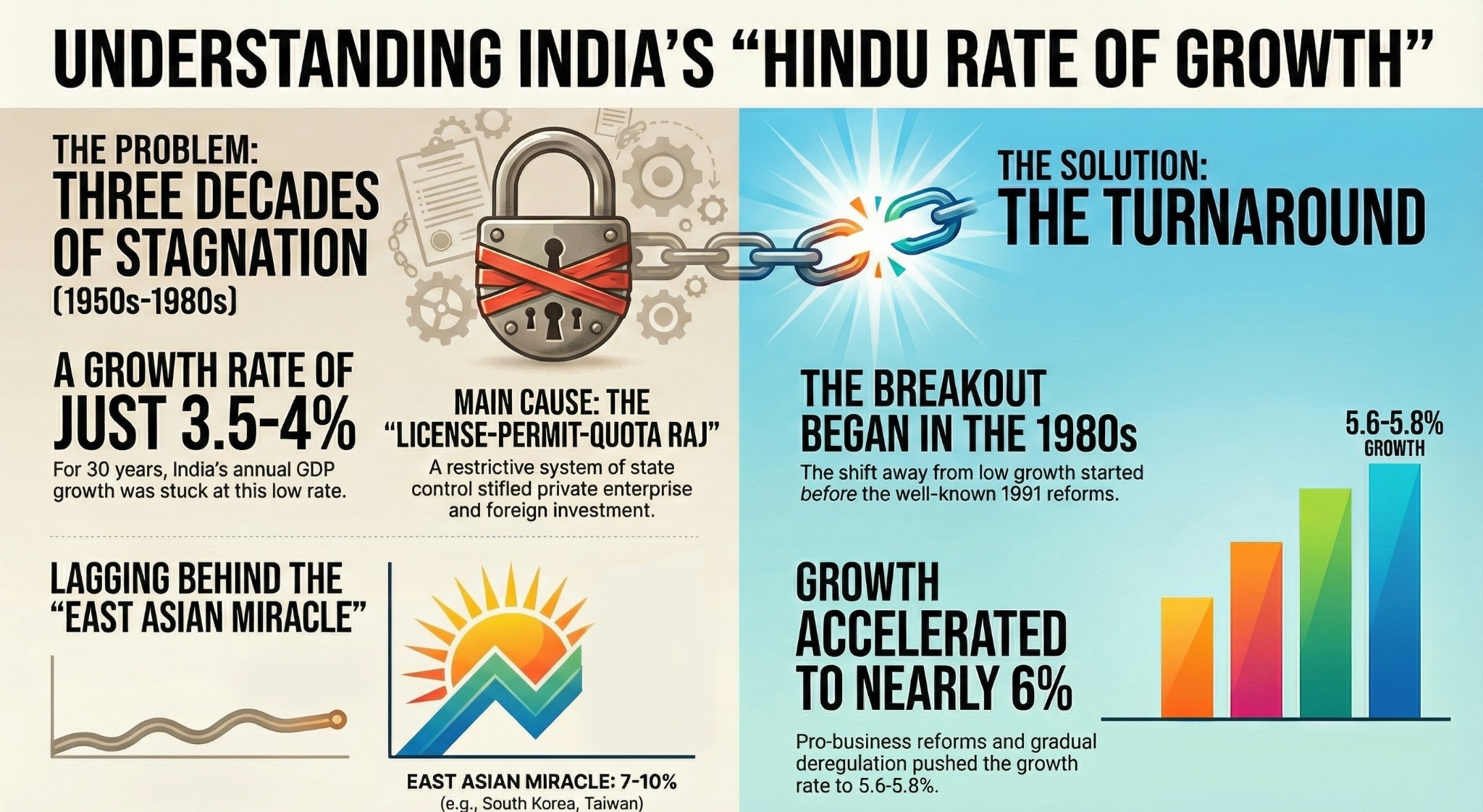
- What it means: The term describes a prolonged period of low annual GDP growth, approximately 3.5% to 4%, that characterized the Indian economy from the 1950s through the 1980s.
- Nature of the term: It refers strictly to long-run real GDP trends and does not imply any technical relationship between religion and economic behavior.
- Origin: The term was coined by economist Raj Krishna of the Delhi School of Economics in the late 1970s (widely cited as 1978).
Key Features of the Era
- Persistent Stagnation: For three decades, India's GDP growth remained stuck at the 3.5–4% mark. Due to high population growth during this period, the actual rise in per capita income was minimal.
- Insularity to Shocks: Economists noted that this growth rate was surprisingly stable or "entrenched", regardless of external or internal shocks, including wars, droughts, famines, or changes in political leadership.
- The "License Raj" Factor: The stagnation is largely attributed to the "License-Permit-Quota Raj", a highly restrictive system characterized by industrial licensing, import substitution, high tariffs, and a lack of private enterprise freedom.
- State-Dominated Model: The economy was "mixed" but heavily tilted toward state control over core industries, financial credit, and trade, which stifled market competition and foreign investment.
Comparative & Historical Context Global Contrast:
- East Asian Miracle: While India languished at ~3.5% growth, peer economies in East Asia (such as South Korea and Taiwan) surged ahead with growth rates of 7–10%, highlighting India's relative underperformance during the post-colonial era.
The Turnaround:
- Pre-1991 Shift: Contrary to popular belief, the break from the "Hindu rate of growth" began before the 1991 liberalization. Studies indicate that growth accelerated to roughly 5.6–5.8% in the 1980s, driven by pro-business reforms and gradual deregulation.
Conclusion
The "Hindu rate of growth" serves as a historical economic marker representing the limitations of India's early central planning and inward-looking policies. Its usage today often sparks debate on whether it reflects cultural determinism or simply describes a bygone era of policy-induced stagnation.