
Planetary-Defense Exercise on 3I/ATLAS
12.12.2025
Planetary-Defense Exercise on 3I/ATLAS
Context
Europe has begun the world’s largest planetary-defence drill to track and analyse the rapidly approaching interstellar object 3I/ATLAS. The live global campaign is being conducted from 27 November 2025 to 27 January 2026, marking an unprecedented international effort in preparedness for near-Earth threats.
About the Planetary-Defense Exercise on 3I/ATLAS
What it is
The 3I/ATLAS planetary-defence exercise is the most extensive global simulation ever undertaken to assess humanity’s capability to detect, track, and respond to potential impact threats. It centres on Comet 3I/ATLAS (C/2025 N1), the third confirmed interstellar object, notable for its unusual, non-gravitational and physics-defying behaviour.
Launched By
The drill is a joint international effort coordinated by:
• ESA (European Space Agency)
• NASA (National Aeronautics and Space Administration)
• UN-IAWN (International Asteroid Warning Network)
• SMPAG (Space Mission Planning Advisory Group)
Aim
• To test global preparedness for high-velocity celestial objects by examining detection capability, early-warning systems, orbital-tracking networks, emergency decision-making, and public communication.
• To identify gaps in multilateral cooperation, data-sharing, and psychological readiness in the event of a real planetary emergency.
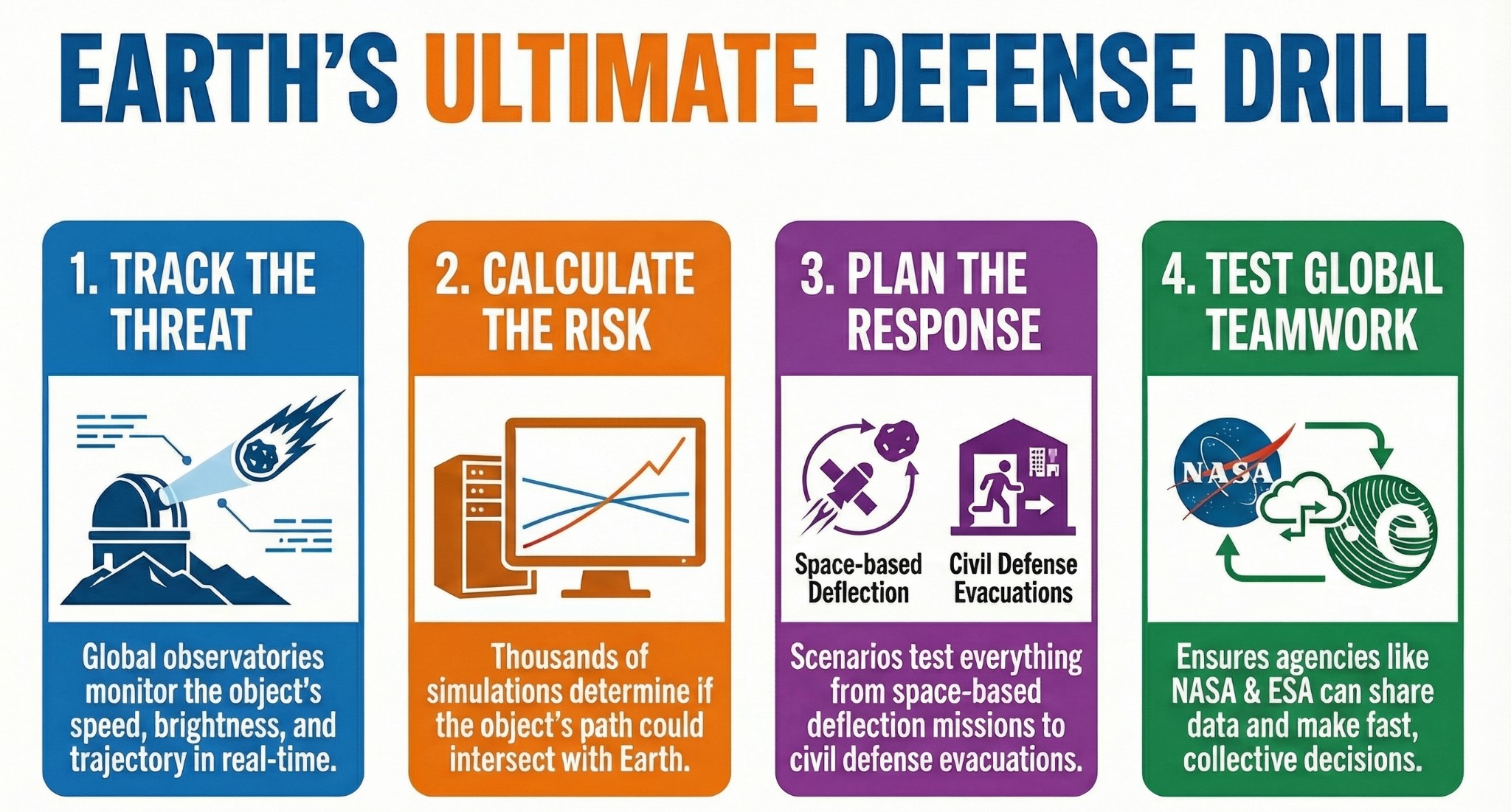
How the Drill Works
1. Tracking 3I/ATLAS
Ground-based observatories and space-borne sensors monitor the comet’s speed, brightness, and trajectory in real time. The object’s rapid movement and unstable behaviour add significant analytical complexity.
2. Analysing Trajectory Shifts
Scientists look for micro-deviations caused by gravitational interactions or solar radiation. Continuous updates refine orbital models to assess whether even slight changes could shift the comet’s distance from Earth.
3. Calculating Impact Probabilities
Thousands of simulations test a wide range of uncertainties. These runs determine whether the interstellar object is likely to remain at a safe distance or if it could intersect Earth’s orbit.
4. Running Global Response Scenarios
Simulated options include:
• Space-based deflection missions (e.g., DART-style kinetic impactors)
• Civil-defence mobilisation
• Evacuation modelling for worst-case scenarios
These stress-test the operational readiness of space and disaster-management agencies.
5. Testing International Coordination
The exercise evaluates how fast and effectively agencies such as NASA, ESA, ISRO, CNSA, JAXA, and UN-IAWN share data, issue alerts, and take collective decisions during high-uncertainty events.
Key Features
• Uses a real, fast-moving interstellar object travelling at ~16–60 km/s, providing unmatched scientific realism.
• Includes orbital-prediction drills, anomaly-response protocols, and planetary-defence modelling.
• Integrates public-communication and misinformation-management modules to assess psychological preparedness.
• Involves military space commands and national disaster agencies for whole-of-government coordination.
• Encourages geopolitical engagement, enabling nations including India, the U.S., and China to accelerate deployment of deep-space monitoring systems such as infrared surveillance satellites.
Significance
• Enhances global readiness for genuine asteroid or comet threats, an emerging planetary-security priority.
• Reveals structural gaps in global emergency communication, including the absence of a unified public-guidance system for space anomalies.
• The comet’s unpredictable behaviour accelerates innovation in surveillance, modelling, and defence technologies, pushing planetary-defence capabilities ahead of existing timelines.