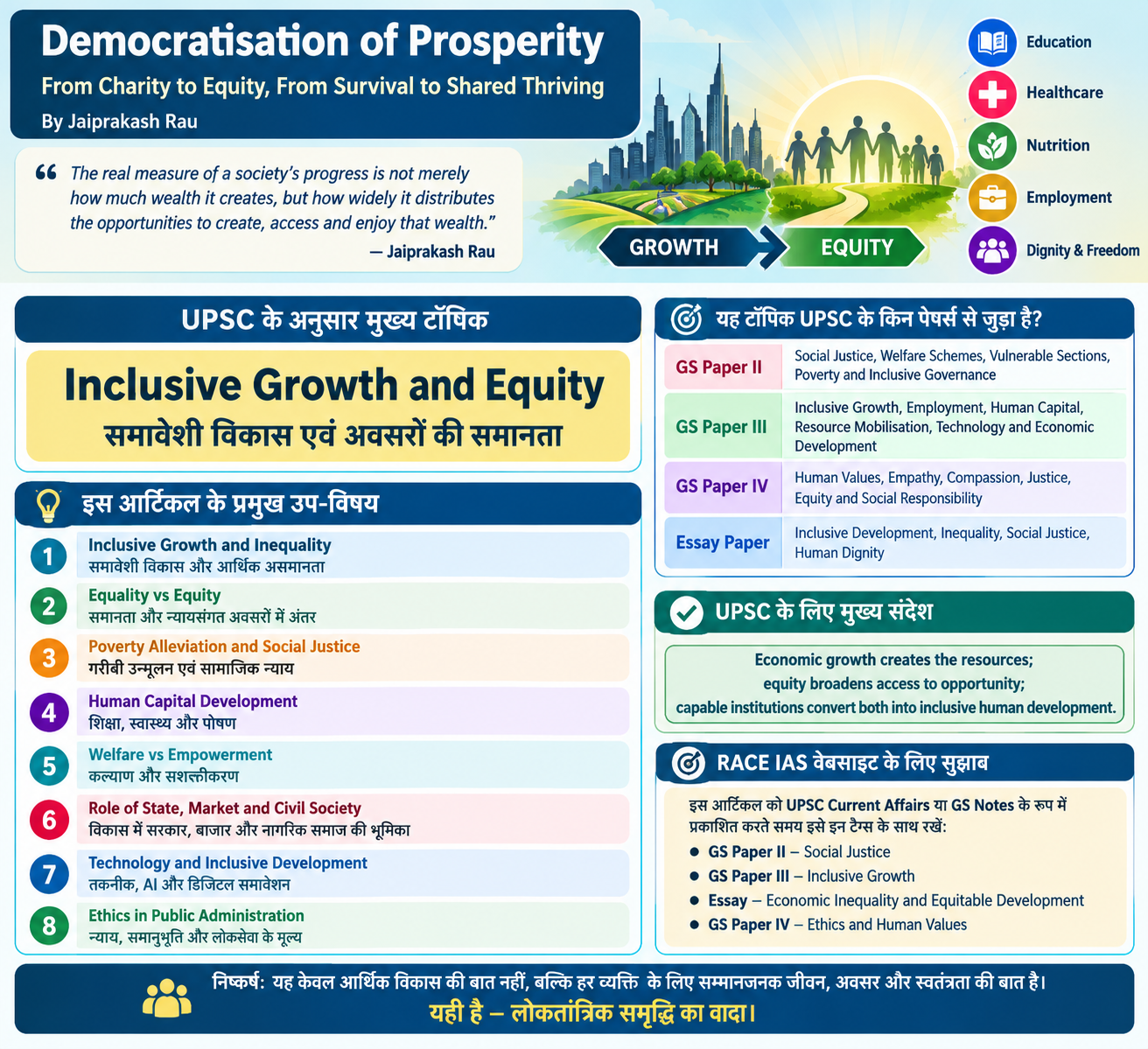
Democratisation of Prosperity: From Charity to Equity, From Survival to Shared Thriving
The real measure of a society’s progress is not merely how much wealth it creates, but how widely it distributes the opportunities to create, access and enjoy that wealth- Jaiprakash Rau
A world capable of producing unprecedented wealth, technological innovation and agricultural abundance continue to confront hunger, deprivation and persistent inequality. While scientific advances have transformed production, digital technologies have connected billions of people and economic growth has lifted millions out of poverty, the benefits of progress remain unevenly distributed. Some enjoy extraordinary economic security and opportunity, while others struggle to secure nutritious food, quality education, affordable healthcare and dignified employment.
This contradiction raises a fundamental question: If humanity has acquired the capacity to generate unprecedented prosperity, why does the ability to enjoy it remain so unequal?
The answer requires us to look beyond the conventional debate on economic growth and poverty alleviation. It calls for a deeper examination of how wealth is created, how opportunities are distributed and how institutions determine who benefits from economic progress.
This is the essence of the democratisation of prosperity—a vision of development in which economic advancement expands the freedom and capabilities of all citizens, rather than concentrating its benefits among a privileged few.
The Paradox of Abundance in a World of Deprivation
For much of human history, poverty was associated with the limited capacity of societies to produce food, goods and services. Today, although scarcity continues to exist in particular regions and sectors, many forms of deprivation coexist with substantial productive capacity, technological sophistication and accumulated wealth.
The challenge, therefore, is not always an absolute shortage of resources. It is also a question of access, purchasing power, institutional arrangements and distribution.
Food may be available in markets, but a household without adequate income cannot necessarily afford a nutritious diet. A university may possess advanced educational resources, but a student from a disadvantaged background may lack the internet access, foundational learning or financial security required to benefit from them. Medical technology may become increasingly sophisticated, but its existence does not guarantee affordable treatment for every citizen.
The existence of a resource and the effective ability to access it are two very different things.
This distinction is central to understanding inequality. Prosperity cannot be measured exclusively through the aggregate value of goods and services produced by an economy. It must also be assessed through the extent to which individuals can translate economic growth into better health, education, security, dignity and freedom of choice.
For UPSC aspirants, this distinction provides an important analytical foundation: economic growth expands the resources available to society, while inclusive development determines how effectively those resources improve human lives.
Why Does Inequality Persist Despite Economic Growth?
It is tempting to attribute inequality entirely to individual greed or a declining willingness to share. Human selfishness can certainly aggravate economic disparities, but systemic inequality cannot be explained through individual morality alone.
It is also shaped by the rules, institutions and historical circumstances within which economic activity takes place.
1. Unequal starting points and the inheritance of advantage
Individuals do not enter economic life with identical resources. Some inherit land, financial assets, social networks and access to high-quality education. Others begin their lives with inadequate nutrition, poor schooling, insecure housing and limited access to productive assets.
These initial differences influence subsequent opportunities. A child who receives good nutrition and quality education is better positioned to acquire skills, compete for employment and accumulate wealth. A child who experiences persistent deprivation may struggle to overcome these disadvantages, even with considerable ability and determination.
Wealth can generate further wealth through investment returns, asset appreciation and intergenerational transfers. Poverty, conversely, can reproduce itself through indebtedness, insecure employment and inadequate human-capital formation.
This does not imply that social mobility is impossible or that individual effort is unimportant. It means that effort operates within a structure of opportunities that is not equally accessible to everyone.
Equity begins by recognising that equal opportunity cannot be achieved merely by treating people identically when their starting conditions are profoundly unequal.
2. The growing importance of capital, technology and ownership
Modern economies increasingly reward the ownership of productive assets, intellectual property, advanced technologies and scalable business platforms.
Technological innovation can raise productivity, create new industries and improve living standards. However, the distribution of its gains depends substantially on who owns the technology, who possesses the necessary skills and how the resulting economic surplus is shared.
Automation and artificial intelligence illustrate this dilemma. They can reduce costs, improve public services and generate new forms of employment. Yet they may also displace certain workers, weaken bargaining power in particular occupations and increase returns to capital relative to labour.
The appropriate response is neither to resist technological progress nor to assume that its benefits will automatically reach everyone. It is to build institutions that facilitate reskilling, support workers through economic transitions, encourage competition and ensure that technological advancement creates broad-based social gains.
The central issue is not whether wealth should be created. It is whether the institutions governing its creation and distribution enable society as a whole to benefit.
3. Unequal access to essential capabilities
Education, healthcare, nutrition, housing, digital connectivity and financial services are not merely items of consumption. They are foundations of economic participation.
A student without adequate schooling cannot compete on equal terms for skilled employment. A worker without access to healthcare may lose income because of illness or incur catastrophic medical expenditure. A small entrepreneur without affordable credit may be unable to invest in productive equipment or expand a viable enterprise.
Such disadvantages reinforce one another, creating cycles of exclusion.
Consequently, the democratisation of prosperity requires more than redistributing income after economic activity has taken place. It also requires expanding the capabilities that enable individuals to participate meaningfully in economic life.
This is where public policy becomes indispensable.
From Equality to Equity: Why Identical Treatment May Not Produce Fairness Equality and equity are related but distinct concepts.
Equality emphasises equal rights, equal treatment and, in appropriate contexts, equal access to public institutions. Equity recognises that individuals may require different forms or levels of support to overcome disadvantages and enjoy genuinely meaningful opportunities.
Consider two students preparing for a competitive examination. One has access to quality schooling, a well-equipped library, reliable internet connectivity and financial support. The other has attended an under-resourced school, lacks adequate study materials and must work to support the family.
Providing both students with the same examination notification satisfies a narrow understanding of formal equality. But it does little to address their unequal preparation conditions.
Equity would seek to improve access to foundational education, learning resources, mentoring and other relevant support for the disadvantaged student, while preserving fair and transparent standards of assessment.
The objective is not to guarantee identical outcomes regardless of effort or performance. It is to reduce avoidable disadvantages that prevent individuals from developing their abilities.
This distinction also matters in public administration. A policy that distributes identical resources to regions with vastly different levels of deprivation may appear neutral but can perpetuate existing disparities. Need-based allocation, by contrast, can direct additional resources towards underserved communities.
However, equity must be pursued through transparent criteria, reliable evidence, accountable institutions and periodic evaluation. Poorly designed targeting can create exclusion errors, administrative discretion and opportunities for political patronage.
Thus, equity is not an abandonment of equality; it is an attempt to make equality of rights and opportunities more meaningful in practice.
Beyond Charity: Building a Society That Shares Prosperity by Design
Charity has an important place in society. Voluntary giving, community kitchens, disaster relief and philanthropic initiatives can provide immediate assistance to people in distress.
Yet charity alone cannot guarantee universal access to essential services or eliminate the institutional causes of deprivation.
A household that depends on occasional donations for food security remains vulnerable to fluctuations in charitable support. A community that lacks adequate healthcare infrastructure cannot permanently resolve its health challenges through periodic medical camps.
The distinction is between relieving the consequences of deprivation and addressing the conditions that reproduce it.
An equity-based model of prosperity must therefore operate through several complementary mechanisms.
1. Universal basic services and investment in human capabilities
Accessible public education, primary healthcare, nutrition, sanitation, safe drinking water and social protection can reduce the disadvantages associated with poverty.
Such services expand individual capabilities while reducing the extent to which access to essential opportunities depends exclusively on household income.
For India, strengthening public schools, primary healthcare centres, Anganwadi services, nutrition programmes and urban and rural infrastructure is particularly important. Their effectiveness depends not merely on budgetary allocations but also on service quality, staffing, local accountability and measurable outcomes.
Public expenditure should therefore be evaluated by the capabilities it creates, not simply by the amount of money spent.
2. Fair taxation and productive public investment
Taxation is one of the principal instruments through which societies finance collective goods and redistribute resources.
A well-designed tax system can ensure that individuals and enterprises contribute according to their legally defined obligations and economic capacity, while generating resources for infrastructure, education, healthcare and social protection.
Progressive taxation can improve the distribution of the tax burden, provided the system is designed to limit evasion, excessive complexity and arbitrary enforcement. Equally important is the productive use of public revenue.
Redistribution without efficient public expenditure can generate limited social returns. Conversely, investment in education, preventive healthcare, transport, research and digital infrastructure can improve productivity while widening access to opportunity.
The objective is not to penalise wealth creation. It is to ensure that private economic success coexists with a fair contribution to the public foundations on which that success partly depends.
3. Fair opportunities for workers and small producers
Economic growth becomes more inclusive when workers, small enterprises, farmers and informal-sector participants can participate in the gains of increased productivity.
This requires attention to labour protections, occupational safety, skill development, access to credit, market connectivity, social security and effective competition.
For small farmers, better storage, irrigation, extension services, market information and access to value chains can improve returns. For micro and small enterprises, affordable finance, simplified compliance and digital market access can support expansion.
The aim should be to strengthen the productive capacity of disadvantaged groups rather than treat them merely as passive recipients of assistance.
An inclusive economy does not simply transfer purchasing power to the poor; it also expands their ability to generate income, acquire assets and exercise economic agency.
4. Democratising access to technology and knowledge
Digital technologies can broaden access to education, financial services, government benefits and markets. However, these benefits depend on reliable connectivity, digital literacy, accessible interfaces, privacy safeguards and effective grievance redressal.
A digital service that is technically available but inaccessible to a person without connectivity, documentation or the ability to navigate it does not deliver universal inclusion.
The same principle applies to artificial intelligence. Its benefits could support education, agriculture, healthcare and public administration, but access to computing resources, quality data and specialised skills remains uneven.
Democratisation therefore requires policies that widen participation in technological progress while protecting citizens from exclusion, surveillance, discrimination and the concentration of market power.
5. Strengthening social mobility across generations
The deepest test of an equitable society is whether a person's life chances are determined primarily by inherited privilege or whether institutions enable individuals to improve their circumstances through education, enterprise, employment and public participation.
Early-childhood nutrition, foundational literacy, school quality, vocational education, scholarships, affordable healthcare and access to productive assets can influence mobility across generations.
These investments have a dual purpose: they improve human welfare today and strengthen the productive potential of the economy tomorrow.
Equity and efficiency are therefore not necessarily opposing objectives. By reducing avoidable barriers to participation, societies can mobilise talent that would otherwise remain underdeveloped.
India’s Development Challenge: From Welfare to Empowerment
India's experience illustrates the importance of combining economic growth with social inclusion.
Economic expansion can generate employment, raise incomes, enlarge the tax base and finance public investment. But the translation of aggregate growth into broad-based prosperity depends on employment quality, educational outcomes, healthcare access, gender equality, regional development and the distribution of productive assets.
India has pursued multiple approaches to inclusion, including the Mahatma Gandhi National Rural Employment Guarantee framework, the National Food Security Act, Ayushman Bharat, public education initiatives, financial inclusion programmes, direct benefit transfers and rural infrastructure development.
These initiatives differ in design and purpose, but they demonstrate that the state can influence access to essential goods, income security and economic participation.
Their success, however, cannot be judged solely by the announcement of schemes, the number of beneficiaries enrolled or the amount of money transferred.
The more meaningful questions are whether households experience improved nutrition, whether children acquire foundational learning, whether healthcare expenses become more manageable, whether employment becomes more productive and whether vulnerable citizens can access their entitlements without discrimination.
Implementation gaps, exclusion errors, regional disparities, weak local institutions and inadequate service quality can undermine otherwise well-intentioned policies.
India must also confront the challenge of creating sufficient productive employment, improving women's participation in the workforce, reducing barriers faced by informal workers and ensuring that growth reaches lagging regions.
This calls for a development strategy that combines a competitive and innovative economy with capable public institutions and a credible social protection system.
Welfare should prevent deprivation; empowerment should expand the capacity to escape it; and productive growth should make both sustainable.
These objectives are complementary rather than mutually exclusive.
The Role of the State, the Market and Civil Society
Democratising prosperity does not require the state to control every aspect of economic activity. Nor does it imply that markets are incapable of generating socially beneficial outcomes.
Markets can coordinate production, encourage innovation, allocate resources and respond to consumer demand. Entrepreneurs can develop technologies, create jobs and introduce products that improve living standards.
But markets primarily respond to effective demand, not to human need in the abstract. A person may urgently require medical treatment but remain unable to purchase it because of inadequate income. An enterprise may be socially valuable but struggle to obtain finance because lenders perceive excessive risk.
Public institutions can address some of these gaps through regulation, public goods, social insurance, competition policy and targeted support.
Civil society, cooperatives, community organisations and philanthropic institutions can complement these efforts by identifying local needs, strengthening participation and holding service providers accountable.
The appropriate balance will vary across sectors. The essential requirement is that institutional arrangements encourage innovation and productive activity without allowing economic power to undermine equal citizenship or access to essential opportunities.
A capable state, a dynamic market and an engaged civil society can reinforce one another when their responsibilities are clearly defined and their performance is subject to accountability.
The Global Dimension: Prosperity in an Unequal World
The democratisation of prosperity is not solely a domestic challenge. It also has an international dimension.
Countries differ substantially in their access to capital, technology, infrastructure, scientific capabilities and resilient supply chains. Historical patterns of industrialisation, unequal bargaining power and disparities in technological capacity influence their development opportunities.
Climate change adds another layer of inequality. Communities that have contributed relatively little to cumulative greenhouse gas emissions can face severe exposure to heatwaves, floods, droughts, coastal erosion and food insecurity. Their capacity to adapt is often constrained by inadequate infrastructure and limited fiscal resources.
An equitable global transition therefore requires more than asking all countries to adopt identical policies regardless of their circumstances. It requires attention to differentiated capacities, access to climate finance, technology transfer, resilient infrastructure and the protection of vulnerable populations.
At the same time, international assistance must support domestic capacity rather than create long-term dependency. Developing countries need opportunities to build skills, strengthen institutions, diversify production and participate in higher-value economic activities.
The underlying principle is universal: global prosperity becomes more durable when the benefits of innovation and development are widely shared and when the costs of economic and environmental disruption do not fall disproportionately on those least able to bear them.
The Difficult Questions: Can Equity Be Pursued Without Sacrificing Efficiency?
An equitable vision of prosperity must confront practical constraints.
Public resources are limited. Poorly targeted subsidies can divert funds from essential services. Excessive regulatory burdens may discourage investment. Weak administrative systems can create leakages, while poorly designed redistribution can produce unintended incentives.
These concerns cannot be dismissed as arguments against equity. They underline the need for sound policy design.
First, governments must distinguish between essential public services, targeted social protection and subsidies that disproportionately benefit those who are already better placed.
Second, fiscal sustainability must remain central. Borrowing to finance productive infrastructure or carefully designed human-capital investments may strengthen future prosperity, whereas persistent expenditure without adequate returns can constrain future policy choices.
Third, policies must be evaluated against evidence. Independent assessment, transparent expenditure data, social audits and outcome-based monitoring can help identify what works and what needs reform.
Fourth, the creation of wealth must remain a priority. Without productivity growth, innovation and investment, the resources available for public services and redistribution will remain constrained.
Finally, social policy must preserve individual agency. People should have the opportunity to make choices, pursue aspirations and benefit from their efforts, while receiving the support necessary to overcome circumstances beyond their control.
The objective is neither absolute equality of income nor the elimination of every economic difference. It is a society in which disparities do not become so entrenched that they deny large sections of the population meaningful opportunities to develop their capabilities.
What Does Democratising Prosperity Ultimately Mean?
The concept brings together three dimensions of development.
The first is the creation of prosperity through productivity, enterprise, innovation, employment and sustainable resource use.
The second is the distribution of opportunity through education, healthcare, fair institutions, access to technology, financial inclusion and social mobility.
The third is the protection of dignity through social security, equal citizenship, freedom from discrimination and the assurance that basic human needs are not left entirely to purchasing power.
These dimensions must operate together. Growth without inclusion can intensify social divisions. Redistribution without productive capacity can become fiscally unsustainable. Welfare without empowerment can leave individuals dependent on continuing assistance.
A durable model of prosperity must therefore combine economic dynamism, distributive fairness and institutional accountability.
The question is not whether every individual can possess the same wealth. It is whether every individual has a fair opportunity to live with dignity, develop their abilities, contribute to society and benefit from collective progress.
Conclusion: From Passive Empathy to Institutional Responsibility
Human beings are capable of generosity, cooperation and compassion. Yet the well-being of millions cannot depend exclusively on the generosity of others.
A society that leaves access to nutrition, healthcare and education entirely to private purchasing power risks converting economic disadvantage into a permanent limitation on human potential. Conversely, a society that builds reliable institutions for essential services, fair opportunity and productive participation can make inclusion a sustained feature of development rather than an occasional act of charity.
The democratisation of prosperity is therefore not a demand that everyone receive an identical share of the wealth created by society. It is a demand that the process of creating wealth, the opportunities to participate in it and the institutions governing its benefits should be compatible with human dignity and social justice.
For India, the challenge is to move beyond a narrow understanding of development measured only by aggregate economic expansion and towards a model that combines growth with capabilities, productivity with protection, and individual aspiration with collective responsibility.
The ultimate test of progress is not merely whether a nation becomes richer, but whether its people acquire greater freedom to shape their own lives.
A prosperous society is not one in which a few have the means to flourish while others struggle to survive. It is one in which prosperity creates the conditions for many more people to flourish.
That is the promise of democratising prosperity: moving from the management of deprivation to the expansion of human potential, and from the morality of sharing to the institutional design of a more equitable society.
UPSC Connection: How Aspirants Should Use This Argument
This theme can be applied to GS-II (welfare, governance, social justice and vulnerable sections), GS-III (inclusive growth, employment, human capital and resource mobilisation), GS-IV (justice, empathy, compassion, integrity and public service values) and the Essay paper.
The most useful analytical distinction to retain is:
Economic growth creates the resources; equity broadens access to opportunity; capable institutions convert both into inclusive human development.
In an examination answer, avoid treating inequality exclusively as a moral failure or assuming that redistribution alone can eliminate it. A balanced response should explain structural barriers, recognise the role of markets and productivity, propose fiscally sustainable interventions and emphasise measurable outcomes.
The guiding question for every policy analysis should be: Does this intervention merely provide temporary relief, or does it also expand people's capabilities, productive participation and long-term freedom to improve their lives?