Facial Recognition Technology (FRT): Balancing Public Surveillance and Fundamental Rights
Facial Recognition Technology (FRT): Balancing Public Surveillance and Fundamental Rights
Introduction
Facial Recognition Technology (FRT) has emerged as one of the most transformative innovations in the fields of governance, policing, and public administration. Powered by Artificial Intelligence (AI), Machine Learning (ML), and computer vision, FRT enables authorities to identify or verify individuals by analyzing their unique facial characteristics. Governments across the world increasingly rely on this technology for crime prevention, border security, missing person identification, and public safety. In India, the adoption of facial recognition systems by law enforcement agencies has accelerated with the expansion of digital surveillance infrastructure and smart policing initiatives. However, alongside its operational advantages, FRT has generated serious concerns regarding privacy, civil liberties, due process, and democratic freedoms. The recent challenge before the Supreme Court of India against the Delhi Police's use of real-time facial recognition to identify students participating in protests over national examination paper leaks has once again highlighted the constitutional questions surrounding biometric surveillance. As India moves towards greater digitization, striking a balance between public security and the protection of fundamental rights has become an important policy imperative.
Understanding Facial Recognition Technology
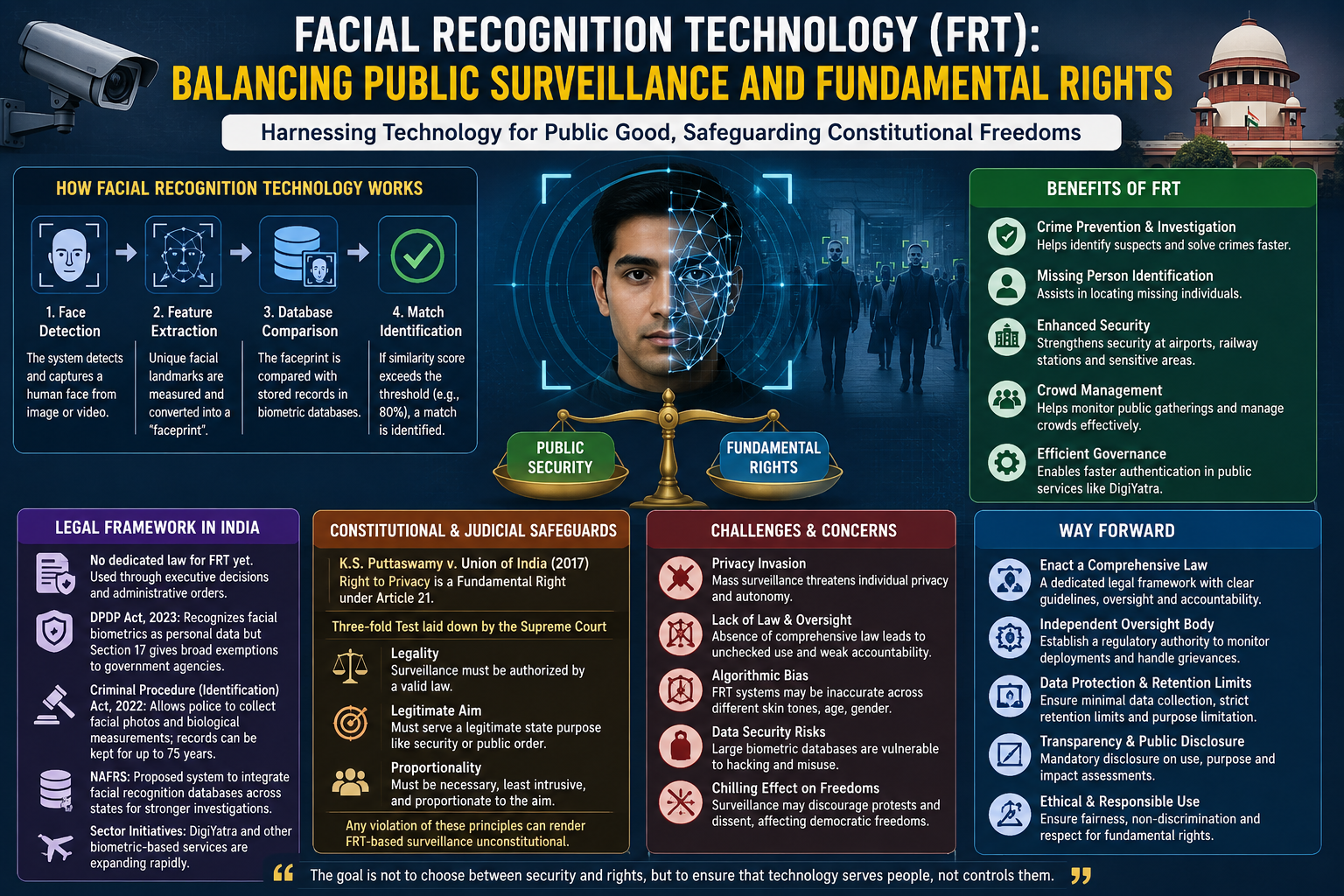
Facial Recognition Technology is a biometric identification system that uses artificial intelligence algorithms to recognize human faces from photographs or live video feeds. The technology functions by first detecting a human face and then identifying distinctive facial landmarks such as the distance between the eyes, the shape of the nose, the contour of the jawline, and other unique facial proportions. These measurements are converted into a mathematical representation known as a faceprint, which serves as a digital biometric identity of an individual.
Once a faceprint is generated, it is compared against existing biometric databases that may contain thousands or even millions of stored facial records. The system calculates a similarity score between the captured image and the stored data. If the similarity exceeds a predetermined threshold, such as 80 percent, the individual is identified as a potential match. Modern facial recognition systems are capable of performing this comparison in real time by continuously scanning crowds through CCTV cameras, drones, or other surveillance devices. Such capabilities make FRT an effective tool for identifying suspects, tracing missing persons, monitoring public gatherings, and strengthening security at airports, railway stations, and other sensitive installations.
Legal Framework Governing Facial Recognition in India
Despite its growing use, India does not yet have a dedicated law specifically regulating Facial Recognition Technology. Most deployments of FRT by law enforcement agencies operate through executive decisions and administrative orders rather than a comprehensive parliamentary statute. This legislative vacuum has raised concerns regarding accountability, transparency, and protection against misuse.
Certain existing laws indirectly regulate biometric data. The Digital Personal Data Protection (DPDP) Act, 2023 recognizes facial biometrics as personal data requiring protection. However, Section 17 of the Act provides broad exemptions to government agencies engaged in law enforcement, public order, and national security functions. Similarly, the Criminal Procedure (Identification) Act, 2022 authorizes police authorities to collect biological measurements, including facial photographs, from arrested persons and convicted individuals. These records may be preserved for up to seventy-five years, enabling the creation of extensive biometric databases.
India has also proposed the National Automated Facial Recognition System (NAFRS) to strengthen criminal investigations by integrating facial recognition databases across states. Additionally, sector-specific initiatives such as DigiYatra, which facilitates seamless airport entry through facial authentication, demonstrate the increasing use of biometrics in public services. However, these initiatives operate under separate administrative guidelines, and India still lacks a unified legal framework that clearly defines permissible uses, oversight mechanisms, data retention standards, and citizens' rights regarding facial recognition.
Constitutional and Judicial Safeguards
The constitutional validity of facial recognition systems must be examined in light of the Right to Privacy, which was recognized as a Fundamental Right by the Supreme Court in the landmark K.S. Puttaswamy v. Union of India (2017) judgment. The Court held that privacy forms an intrinsic part of the right to life and personal liberty guaranteed under Article 21 of the Constitution.
The judgment established a three-fold test that every State action involving surveillance or collection of personal data must satisfy. First, there must be legality, meaning the action should be authorized by a valid law enacted by the legislature. Second, there must be a legitimate state aim, such as protecting national security, maintaining public order, or preventing serious crime. Third, the action must satisfy the principle of proportionality, ensuring that the intrusion into individual privacy is necessary and represents the least restrictive means of achieving the intended objective.
The admissibility of facial recognition evidence is also subject to the Bharatiya Sakshya Adhiniyam (BSA), under which electronic records must meet standards relating to authenticity, integrity, chain of custody, and system reliability. These safeguards are essential because algorithmic outputs should not automatically be treated as conclusive evidence in criminal proceedings.
Benefits of Facial Recognition Technology
When deployed responsibly, Facial Recognition Technology offers significant advantages for governance and public administration. It enables law enforcement agencies to rapidly identify criminals, trace missing children, locate trafficked persons, and verify identities during investigations. Real-time identification allows security agencies to respond more quickly to potential threats in crowded public spaces, thereby strengthening preventive policing.
FRT also enhances administrative efficiency by reducing dependence on manual verification procedures. Airports, government offices, and other public institutions increasingly use facial authentication to provide faster, contactless, and secure access to services. During emergencies or natural disasters, facial recognition systems can assist authorities in identifying victims and reuniting families. Furthermore, the technology supports digital governance by enabling seamless identity verification across various public services while reducing fraud and impersonation.
Challenges and Ethical Concerns
Despite its benefits, Facial Recognition Technology presents significant legal, ethical, and operational challenges. Unlike fingerprints or DNA evidence, facial recognition is inherently probabilistic rather than absolute. The technology relies on similarity scores instead of certainty, making it susceptible to false positives and false negatives. Variations in lighting conditions, camera angles, facial expressions, ageing, or poor-quality images can significantly reduce accuracy and result in innocent individuals being mistakenly identified as suspects.
Another major concern is the possibility of mass surveillance. Continuous monitoring of public spaces through facial recognition can create a chilling effect on democratic participation. Citizens may avoid participating in peaceful protests, political meetings, or public demonstrations out of fear that their identities are being permanently recorded and monitored. Such surveillance has direct implications for the freedoms guaranteed under Article 19, including the freedom of speech and expression and the right to peaceful assembly.
Data security also remains a critical issue. Unlike passwords or identity cards, facial characteristics cannot be changed if compromised. A breach of a centralized biometric database could expose individuals to irreversible identity theft and long-term privacy risks. Furthermore, many facial recognition algorithms have been found to exhibit demographic bias due to unbalanced training datasets, leading to higher error rates for women, minority communities, and certain ethnic groups. The widespread use of proprietary "black-box" AI systems further limits transparency because individuals accused on the basis of algorithmic matches may be unable to challenge the underlying logic of the software in judicial proceedings.
The Way Forward
The increasing deployment of Facial Recognition Technology demands a comprehensive governance framework that balances technological innovation with constitutional safeguards. India should enact dedicated legislation specifically regulating biometric surveillance, clearly defining permissible purposes, authorization procedures, retention periods, and safeguards against misuse. Such legislation should incorporate the principles laid down by the Supreme Court in the Puttaswamy judgment and ensure that surveillance measures satisfy the tests of legality, necessity, and proportionality.
Independent oversight mechanisms are equally important. A specialized regulatory authority should periodically audit facial recognition systems, monitor compliance with privacy standards, assess algorithmic fairness, and investigate complaints of misuse. Mandatory publication of accuracy benchmarks, false-positive rates, and independent performance audits would enhance transparency and public trust.
Governments should also promote Explainable Artificial Intelligence (XAI) so that algorithmic decisions remain transparent and subject to judicial scrutiny. Automated facial recognition matches should never serve as the sole basis for detention or arrest. Instead, every match must be independently verified by trained human officers before any legal action is initiated. Effective grievance redressal mechanisms should also be established to provide timely remedies for individuals wrongly identified by automated systems. By adopting the principles of Responsible AI, as advocated by NITI Aayog, India can ensure that technological advancement remains consistent with democratic values and constitutional governance.
Conclusion
Facial Recognition Technology represents one of the defining technologies of the digital age. Its ability to enhance policing, strengthen public security, and improve administrative efficiency makes it an important instrument for modern governance. At the same time, its unchecked deployment poses serious risks to privacy, civil liberties, due process, and democratic participation. The absence of a dedicated legal framework further intensifies these concerns by leaving significant gaps in accountability and oversight. The challenge before policymakers is not whether facial recognition should be used, but how it should be regulated. A balanced framework based on comprehensive legislation, independent oversight, transparent algorithms, robust data protection, and meaningful judicial safeguards can ensure that the benefits of Facial Recognition Technology are realized without compromising the fundamental rights guaranteed by the Constitution. In a constitutional democracy like India, technological progress must always remain subordinate to the principles of liberty, accountability, and the rule of law.