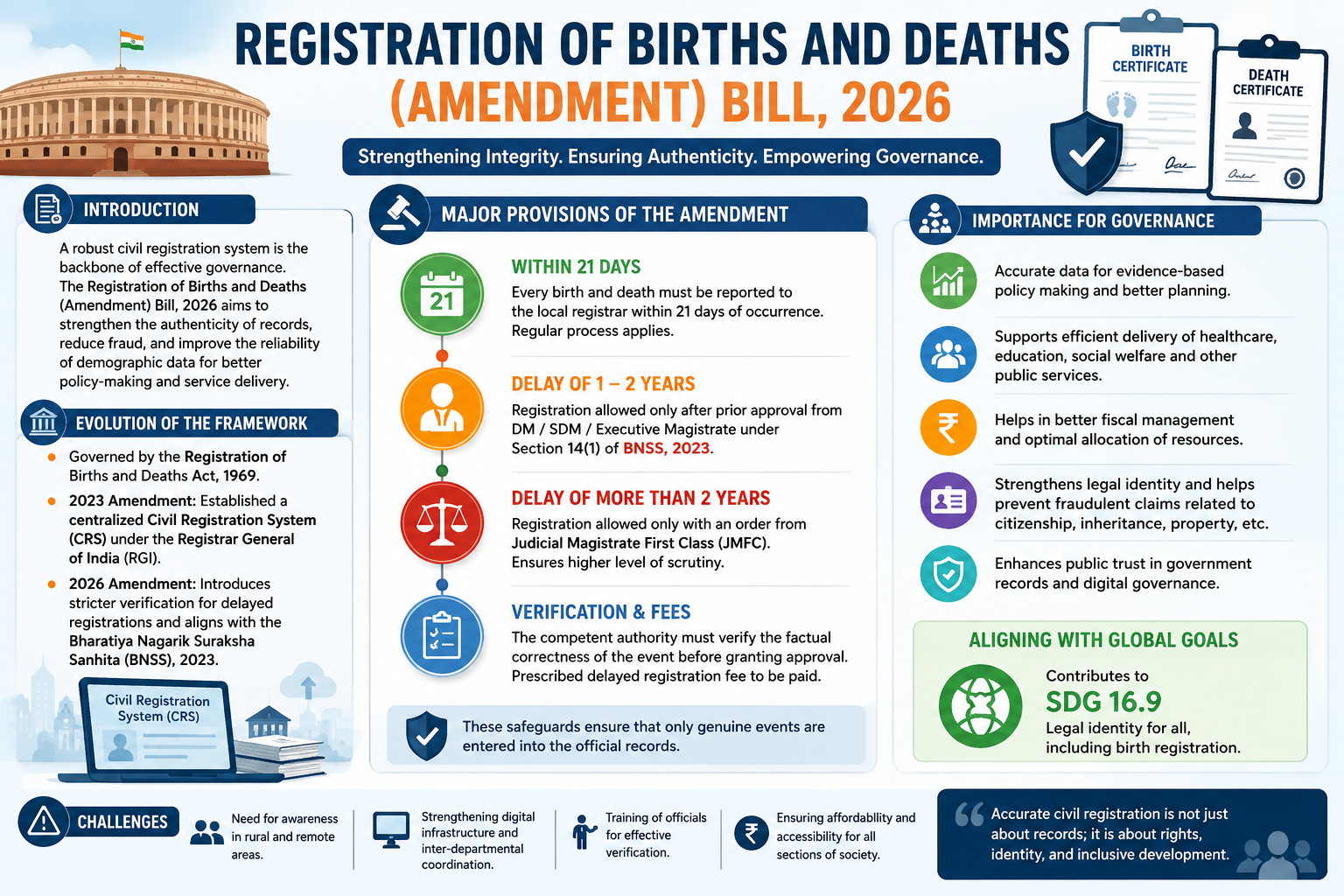
Registration of Births and Deaths (Amendment) Bill, 2026
Registration of Births and Deaths (Amendment) Bill, 2026
Introduction
A robust civil registration system forms the backbone of an effective governance framework. Birth and death certificates are among the most important legal documents issued by the State, serving as the foundation for identity, citizenship, inheritance, social security, education, healthcare, and numerous other public services. Recognizing the growing need to safeguard the authenticity of these records, the Parliament passed the Registration of Births and Deaths (Amendment) Bill, 2026. The legislation seeks to strengthen the integrity of India's civil registration mechanism by introducing stricter procedures for delayed registration of births and deaths, reducing fraudulent entries, and improving the reliability of demographic data used in policy formulation. The amendment also aligns the law with the Bharatiya Nagarik Suraksha Sanhita (BNSS), 2023, while reinforcing judicial oversight in cases involving significant delays. As India increasingly relies on digital governance and data-driven policymaking, the amendment represents an important step towards creating a more credible, transparent, and efficient civil registration system.
Evolution of the Civil Registration Framework
India's legal framework for registering births and deaths is governed by the Registration of Births and Deaths Act, 1969, which made it compulsory to register every birth and death occurring within the country. Over the years, the importance of accurate civil registration has expanded beyond maintaining vital statistics. Today, birth and death records support numerous welfare schemes, identity verification systems, electoral rolls, and demographic planning.
A major reform occurred in 2023, when the Act was amended to establish a centralized Civil Registration System (CRS) under the supervision of the Registrar General of India (RGI). The digital platform aimed to create a unified national database that could be seamlessly integrated with other government databases, thereby improving service delivery and administrative efficiency. However, despite digitalization, concerns continued regarding delayed registrations, particularly those occurring several years after the actual event. Such delayed registrations sometimes created opportunities for fraudulent claims relating to citizenship, inheritance, immigration, and property disputes. The 2026 amendment addresses these concerns by establishing a more rigorous verification mechanism.
Major Provisions of the Amendment
The most significant feature of the amendment is the introduction of a tiered approval system based on the length of delay in registration. The law continues to require that every birth and death be reported to the designated local registrar within 21 days of its occurrence. Registrations completed within this period follow the regular administrative process without additional scrutiny.
Where the delay extends between one and two years, registration can only be permitted after obtaining prior approval from the District Magistrate (DM), Sub-Divisional Magistrate (SDM), or an authorized Executive Magistrate as provided under Section 14(1) of the Bharatiya Nagarik Suraksha Sanhita, 2023. These authorities are responsible for examining the supporting evidence and verifying the authenticity of the reported event before granting permission.
For registrations delayed by more than two years, the amendment introduces a higher level of scrutiny by requiring a formal order from a Judicial Magistrate First Class (JMFC). This represents a significant shift from executive oversight to judicial supervision in cases where the possibility of fraud is comparatively higher.
The amendment further provides that the competent authority must verify the factual correctness of the reported birth or death before registration is allowed. Applicants are also required to pay the prescribed delayed registration fee. These safeguards collectively seek to ensure that only genuine claims are entered into the official records.
Importance for Governance and Public Administration
Accurate civil registration is essential for efficient governance. Government policies relating to healthcare, education, employment, urban planning, disaster management, and social welfare depend heavily on reliable demographic information. Incorrect or manipulated birth and death records distort population statistics and weaken evidence-based policymaking.
The amendment strengthens the credibility of India's demographic databases by ensuring that delayed registrations undergo appropriate verification before becoming part of the official record. Reliable civil registration data enables governments to estimate population growth, fertility rates, mortality patterns, life expectancy, migration trends, and age distribution more accurately. Such information is indispensable for planning hospitals, schools, infrastructure projects, vaccination campaigns, and public health interventions.
The amendment also contributes to improved fiscal management by helping governments allocate resources more efficiently according to actual demographic needs rather than inaccurate or inflated records.
Enhancing Identity Security and Welfare Delivery
One of the major objectives of the amendment is to protect the integrity of legal identity documents. Birth certificates often serve as the first official proof of identity and are subsequently used for obtaining passports, Aadhaar, voter identity cards, educational admissions, employment, inheritance claims, and citizenship verification. Death certificates are equally important for succession, insurance settlements, pension claims, and closure of official records.
Fraudulent delayed registrations have occasionally been used to establish false identities or create fictitious beneficiaries. By introducing judicial scrutiny for long-delayed cases, the amendment reduces opportunities for retrospective manipulation of official records.
The reform also improves the quality of beneficiary databases used under various welfare programmes. Government initiatives based on Direct Benefit Transfer (DBT) require accurate identification of beneficiaries to ensure that subsidies, pensions, scholarships, and welfare payments reach genuine recipients. Reliable birth and death records help eliminate duplicate, ghost, or deceased beneficiaries from government databases, thereby improving transparency and reducing leakages in public expenditure.
Furthermore, improved registration strengthens the accuracy of interconnected national databases such as the National Population Register (NPR), electoral rolls, and digital identity systems, contributing to more efficient governance.
Constitutional and International Significance
The amendment carries important constitutional implications by reinforcing the principle of separation of powers embodied in Article 50 of the Constitution. By transferring approval for registrations delayed beyond two years from executive authorities to Judicial Magistrates, the law introduces an independent layer of scrutiny that enhances public confidence in the registration process. Judicial oversight reduces the possibility of arbitrary administrative decisions while strengthening procedural fairness.
The legislation also supports India's commitment to the Sustainable Development Goals (SDGs), particularly SDG 16.9, which calls for providing legal identity for all, including birth registration, by 2030. Universal registration not only safeguards individual rights but also promotes inclusive development by ensuring that every individual can access public services and legal protections throughout life.
In the broader context of digital governance, credible civil registration systems also facilitate evidence-based policymaking, international statistical reporting, and monitoring of developmental indicators.
Challenges in Implementation
Despite its potential benefits, the amendment may face several practical challenges during implementation. One of the foremost concerns relates to the additional burden placed on the judiciary. India already has a substantial backlog of pending cases in subordinate courts. Requiring Judicial Magistrates to approve every registration delayed by more than two years could increase workloads unless adequate institutional capacity is created.
Administrative delays may also affect ordinary citizens. Individuals seeking delayed birth or death certificates often require these documents urgently for pension claims, property transfers, insurance settlements, educational admissions, or correction of official records. Lengthy verification procedures could unintentionally delay access to essential services.
Another challenge arises from the country's digital divide. Although the Civil Registration System has improved accessibility in many areas, internet connectivity, digital literacy, and technological infrastructure remain uneven across rural, tribal, and remote regions. Elderly citizens, economically weaker sections, and marginalized communities may continue to face difficulties in accessing digital registration facilities without adequate assistance.
The success of the amendment will therefore depend not only on legal provisions but also on administrative preparedness, institutional coordination, and citizen awareness.
Way Forward and Conclusion
Effective implementation of the Registration of Births and Deaths (Amendment) Bill, 2026 requires a balanced approach that combines rigorous verification with citizen-friendly service delivery. Dedicated summary procedures or fast-track mechanisms may be introduced to enable Judicial Magistrates to dispose of delayed registration applications efficiently without adding to existing court backlogs. Standard operating procedures should ensure uniform verification practices across states while minimizing procedural delays.
Expanding assisted registration facilities through Common Service Centres (CSCs), Gram Panchayats, municipal offices, and local health institutions can help bridge the digital divide. Capacity building of registration officials, integration of hospital records with the Civil Registration System, and widespread public awareness campaigns regarding the mandatory 21-day reporting period will further improve compliance and reduce the need for delayed registrations.
In conclusion, the Registration of Births and Deaths (Amendment) Bill, 2026 represents a significant reform aimed at protecting the authenticity of India's civil registration system. By strengthening verification mechanisms, introducing judicial oversight for long-delayed cases, and enhancing the reliability of demographic databases, the legislation supports transparent governance, efficient welfare delivery, and evidence-based policymaking. Whether its success will depend upon the effectiveness of the recent policy execution .