White Gold: Revolutionizing India’s Cotton Sector from Seed to Shirt
White Gold: Revolutionizing India’s Cotton Sector from Seed to Shirt
Cotton has long been revered as "White Gold" in India, serving as an irreplaceable cornerstone of the nation’s socio-economic matrix. Beyond being a primary raw material for garments, cotton represents a vital agricultural asset that sustains millions of livelihoods, fuels rural economies, and anchors India's global trade footprint. A recent feature by the Press Information Bureau (PIB) titled "White Gold: India’s Cotton Story – From Seed to Shirt" highlights the central role this natural fiber plays in realizing the vision of an Atmanirbhar Bharat (Self-Reliant India). As the nation seeks to modernize its industrial capabilities, the story of Indian cotton reflects a transformation driven by technological integration, brand building, quality assurance, and sustainable agricultural practices.
Global Leadership and the Legacy of Indian Cotton
India holds a unique and historic position in global agriculture as the world’s leading producer of cotton and the country with the largest area dedicated to cotton cultivation. Covering sprawling fields across the northern, central, and southern zones, cotton cultivation in India is marked by distinct geographical diversity. Furthermore, India stands out as the only country in the world that commercially cultivates all four major species of cultivated cotton: Gossypium arboreum, G. herbaceum, G. hirsutum, and G. barbadense, alongside various hybrid varieties. This biological diversity provides Indian cotton farmers with a flexible genetic pool capable of adapting to varying regional climates, soil profiles, and regional agronomic demands.
The national significance of this crop extends beyond field acreage. Over centuries, cotton has evolved from a traditional agricultural commodity into a sophisticated industrial supply chain. Today, India’s cotton crop serves as the primary backbone for its domestic textile and apparel sectors, which form one of the oldest and largest manufacturing pillars in the country. The dominance of Indian cotton on the global stage ensures that changes within the domestic sector resonate throughout international supply chains, placing India in a strong position to influence global textile standards and market trends.
Socio-Economic Dimensions Across the Textile Value Chain
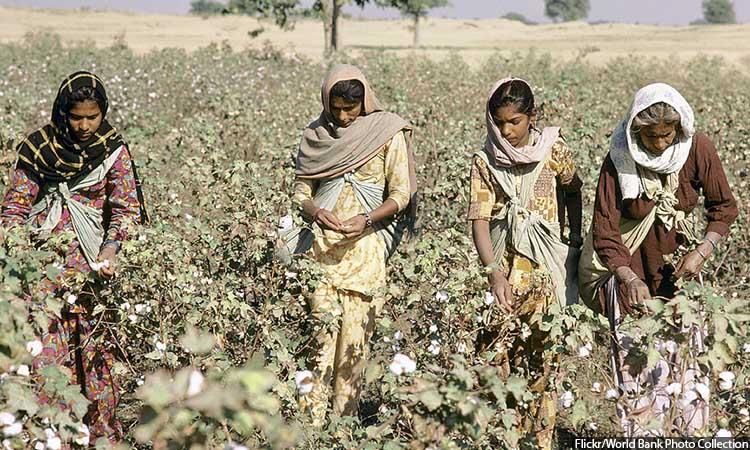
The socio-economic impact of cotton on the Indian economy is vast and multi-layered. At the production end, the crop directly supports more than six million farming households, many of whom rely on seasonal cotton yields as their principal source of income. Because cotton farming demands intensive labor during sowing, weeding, picking, and post-harvest handling, it generates millions of agrarian employment days annually, particularly benefiting rural women and marginal laborers.
Beyond the farm gate, cotton powers an extensive industrial ecosystem. The textile value chain spanning ginning mills, spinning units, weaving clusters, processing facilities, and garment manufacturing centers, which provides direct and indirect employment to approximately 40 to 50 million people nationwide. This makes the cotton-textile sector second only to core agriculture in terms of total employment generation. Consequently, any strategic improvement in cotton productivity or market stability creates direct dividends across both rural communities and urban industrial hubs.
The 5F Vision: Guiding the Journey from Farm to Foreign Shores
To streamline this vast and complex ecosystem, the Government of India has articulated a clear policy framework: the 5F Strategy. Representing Farm to Fibre, Fibre to Fabric, Fabric to Fashion, and Fashion to Foreign, this holistic vision aims to integrate every segment of the supply chain rather than viewing agriculture, textile processing, and garment manufacturing as isolated sectors.
By strengthening the linkages between these stages, the 5F strategy focuses on maximizing value addition at every step within national borders. Instead of exporting low-value raw lint, the emphasis has shifted toward processing raw fiber into high-quality yarn, converting yarn into fine fabrics, designing market-ready fashion, and supplying finished garments to global markets. This integrated policy framework directly enhances export earnings, creates skilled industrial jobs, and secures higher profit margins for domestic enterprises, reinforcing the spirit of Atmanirbhar Bharat.
Technological Interventions and Quality Infrastructure
To compete effectively on the world stage, quality standards and supply chain transparency are essential. A flagship step in this direction is the launch of Kasturi Cotton Bharat, a national initiative designed to establish a premium global brand for Indian cotton. Under this program, cotton meeting strict criteria regarding fiber length, strength, fineness, and low trash content receives certified branding, instantly signaling high quality to international buyers and spinners.
Complementing branding efforts is the integration of digital traceability solutions, such as Blockchain and QR code tagging. These technologies allow buyers to trace cotton bales back through the ginning process to their regional origin. Digital traceability assures international consumers about ethical sourcing, purity, and quality metrics, overcoming long-standing challenges related to contamination and variable quality control in raw cotton exports.
Empowering Farmers through Digital Tools and Financial Security
Recognizing that sustainable growth begins at the foundational level, several initiatives focus directly on farmer welfare and income security. Digital tools like the Cott-Ally and Kapas Kisan mobile applications provide farmers with direct access to critical, real-time information. Through these platforms, growers receive timely weather updates, crop health advisories, pest control guidelines, live procurement schedules, and direct status updates on sales payments.
Financially, the government protects cotton farmers from market volatility through structured Minimum Support Price (MSP) operations. The Cotton Corporation of India (CCI) acts as a stabilizing agency, entering the market to purchase raw seed cotton (kapas) directly from farmers whenever market prices fall below the designated support thresholds. This price safety net prevents distress sales, protects rural incomes during surplus years, and provides smallholder farmers with the financial confidence needed to re-invest in quality seeds and modern farming inputs.
Critical Challenges Facing the Cotton Sector
Despite its strategic advantages, India’s cotton ecosystem faces significant structural and biological hurdles. On the agricultural front, the rising resistance of pests like the Pink Bollworm (PBW) poses an ongoing threat to crop yields and quality. Over the past decade, PBW infestations have compromised yields across several major cotton-growing states, forcing farmers to increase pesticide expenditure and reducing total net profits. Additionally, a large proportion of Indian cotton relies on rainfed agriculture, leaving crop outcomes vulnerable to monsoon irregularities, delayed rainfall, and groundwater depletion.
In addition to pest pressures, overall crop productivity in terms of yield per hectare remains below the global average. Post-harvest handling practices present another major challenge; manual picking and improper storage often introduce trash and moisture into raw cotton bolls, degrading fiber quality prior to ginning. Addressing these vulnerabilities requires concerted efforts in agronomic research, infrastructure development, and sustainable farm practices.
Strategic Roadmap for Sustainable Growth
Overcoming these challenges requires a forward-looking approach focused on modernization and sustainability. Yield enhancement can be accelerated through the widespread adoption of the High-Density Planting System (HDPS), which optimizes plant spacing to increase yield per unit area. Coupled with the rollout of climate-resilient, pest-resistant seed varieties under targeted missions, these agronomic strategies can elevate national productivity levels closer to global benchmarks.
Furthermore, expanding modern irrigation techniques—such as micro-drip and precision irrigation—is critical to reduce vulnerability to unpredictable weather patterns. Looking beyond raw lint, expanding into high-value segments like technical textiles, organic cotton, and eco-certified apparel will allow Indian manufacturers to capture premium price points in international markets. By pairing digital traceability with sustainable, eco-friendly farming practices, India can solidify its reputation as a reliable and responsible source of premium natural fibers.
Through this multi-faceted focus on productivity, quality assurance, digital integration, and value addition, India’s cotton story continues to evolve. By empowering smallholder farmers and modernizing every link of the textile value chain, "White Gold" will remain a vital engine of economic prosperity, industrial growth, and global trade for decades to come.