Disaster Management & the Indian Economy: Balancing Growth with Resilience
Disaster Management & the Indian Economy: Balancing Growth with Resilience
In early 2026, the report “Enhancing Disaster Risk Financing” released by the Organisation for Economic Co-operation and Development (OECD) brought renewed attention to a fundamental challenge confronting India. The country is among the fastest-growing major economies in the world, yet it is simultaneously one of the most disaster-prone. Rapid urbanisation, industrial concentration, and climate variability have transformed natural hazards from episodic shocks into persistent economic stressors. Disaster management is no longer confined to emergency response; it now directly influences fiscal stability, infrastructure investment, and the long-term sustainability of development.
The Structural Economic Burden of Disasters
Natural disasters impose a chronic economic cost on India rather than an occasional setback. Between 1990 and 2024, average annual losses from floods, cyclones, droughts, and landslides amounted to nearly 0.4% of GDP. This figure represents a continuous drain on national resources, capital that could otherwise have financed education, health, or productivity-enhancing infrastructure. Unlike one-time shocks, this recurring loss behaves like a structural tax on growth, quietly eroding development gains year after year.
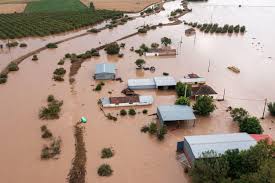
The impact becomes especially visible during extreme events. The 2015 floods in Chennai and the 2018 floods in Kerala caused economic damage running into billions of dollars within days, overwhelming state finances and diverting public expenditure from development to reconstruction. While reconstruction spending may temporarily raise GDP figures, it merely replaces destroyed assets rather than creating new productive capacity, masking the real economic loss.
Industrial Concentration and High-Risk Growth Zones
India’s growth model relies heavily on a few highly industrialised and urbanised states that also face elevated climate risks. Coastal and western states such as Gujarat, Maharashtra, and Tamil Nadu together contribute a substantial share of national manufacturing output and exports. At the same time, these regions are highly exposed to cyclones, storm surges, extreme rainfall, and urban flooding.
Current estimates suggest that nearly 36% of India’s industrial output originates from disaster-prone zones. This concentration creates systemic risk: disruptions to ports, power supply, transport networks, or industrial clusters can ripple through national supply chains. Climate-related losses are therefore not just localised humanitarian concerns but macroeconomic vulnerabilities that affect investment confidence, employment, and export competitiveness.
India in the Global Risk Landscape
The World Risk Report 2025/26 places India as the second most at-risk country in Asia, behind only the Philippines. Globally, India remains within the top tier of countries facing long-term climate-related economic risks, as highlighted by the Germanwatch Climate Risk Index. This high ranking is not driven solely by the intensity of hazards but by the interaction of exposure and vulnerability.
India’s large population means that even moderate floods or heatwaves affect millions of people. Dense settlement in river basins, deltas, and coastal belts amplifies the economic and social impact of relatively frequent events. The risk profile is therefore shaped less by rare catastrophes and more by the cumulative effect of repeated, medium-scale disasters that steadily undermine resilience.
Why India’s Disaster Risk Remains Elevated
A defining feature of India’s vulnerability is the frequency and persistence of hazards. More than 80 million people are affected by disasters each year, making recovery an ongoing challenge rather than a finite process. Much of this vulnerability is hydrological in nature like riverine floods, flash floods, landslides, and waterlogging rather than sporadic mega-storms.
Another critical factor is the recovery lag. Often, households, small enterprises, and local governments are still rebuilding from one disaster when another strikes. This “continuous threat” cycle prevents the accumulation of savings and resilience, locking communities into a pattern of repeated loss. Over time, this dynamic translates into higher poverty risk, fiscal stress for states, and slower overall economic convergence.
Policy Shift: From Relief-Centric to Resilience-Oriented Governance
Recognising these structural challenges, India has begun to reorient its disaster management framework from reactive relief toward proactive resilience. Disaster Risk Finance (DRF) has emerged as a central pillar of this transition. Under the 15th Finance Commission (2021–26), the disaster funding architecture was redesigned to earmark a significant share of resources for mitigation and preparedness, rather than allocating nearly all funds to post-disaster response.
A major institutional innovation is the Coalition for Disaster Resilient Infrastructure (CDRI), launched by India in 2019 with its secretariat in New Delhi. With over 50 member countries, CDRI works to integrate climate resilience into power systems, transport networks, and urban infrastructure. By influencing global standards, it positions India not just as a risk-affected country but as a norm-setter in resilient development.
Legal reforms have reinforced this shift. The Disaster Management (Amendment) Bill, 2024 strengthened the statutory framework for data collection, risk assessment, and the implementation of finance commission recommendations, improving coordination between the Union and the states.
Redefining Growth: The Transition from GDP to NDP
One of the most significant conceptual shifts underway is India’s planned move toward Net Domestic Product (NDP) as a core indicator of economic performance by 2029–30. In line with the United Nations’ updated Systems of National Accounts, NDP deducts depreciation of capital assets and environmental degradation from gross output.
This change is particularly relevant for disaster-prone economies. Under GDP accounting, reconstruction after floods or cyclones appears as positive economic activity, even though it merely restores lost assets. NDP, by contrast, subtracts disaster-related capital loss, revealing the true net impact of growth. By making losses visible in headline economic metrics, NDP creates incentives for states to invest in resilient infrastructure, enforce land-use planning, and reduce long-term risk rather than relying on repeated reconstruction.
Conclusion: Toward Resilient and Inclusive Growth
India’s economic trajectory remains strong, but it is persistently moderated by a structural disaster-related loss equivalent to about 0.4% of GDP each year. The year 2026 marks a decisive moment in recognising disaster management as a core component of fiscal and economic policy rather than a peripheral emergency function. Through data-driven disaster risk financing, global leadership via the CDRI, legal reforms, and a forward-looking shift toward NDP-based accounting, India is laying the foundations of a more resilient growth model. The challenge ahead is to ensure that rapid economic expansion is matched by equally robust resilience, allowing India’s development to be not only fast, but durable, inclusive, and climate-secure in the decades to come.