Dugong Conservation in India
Dugong Conservation in India
The dugong (Dugong dugon), often called the sea cow, is one of India’s most vulnerable marine mammals. Recent assessments, including the 2025 IUCN report, indicate that dugong populations in the Gulf of Kutch and the Andaman & Nicobar Islands are facing severe uncertainty due to habitat degradation, pollution, overfishing, and maritime disturbances. Even the relatively better-protected Palk Bay–Gulf of Mannar population has declined, highlighting the urgent need for enhanced conservation measures. These developments have prompted intensified conservation efforts across the country, including habitat protection, community engagement, and policy reforms, aimed at securing the survival of this ecologically important species.
Dugongs inhabit warm, shallow coastal waters and play a vital ecological role by feeding on seagrass meadows, which act as blue carbon sinks and support coastal biodiversity. In India, they are primarily found in Palk Bay–Gulf of Mannar (Tamil Nadu), the Andaman & Nicobar Islands, and the Gulf of Kutch (Gujarat). Their dwindling populations underscore the urgency of implementing robust conservation strategies.
Key Characteristics
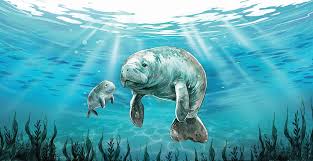
Dugongs are large, streamlined marine mammals, growing up to three meters in length and weighing 300–420 kilograms. They possess broad, paddle-shaped flippers and a whale-like tail, allowing efficient navigation in shallow waters. Dugongs are strictly herbivorous, feeding almost exclusively on seagrass, consuming 30–40 kilograms daily. Their grazing maintains healthy seagrass meadows, which are critical for marine biodiversity and serve as carbon sinks that mitigate climate change. Dugongs in India are classified as Vulnerable on the IUCN Red List and enjoy Schedule I protection under the Wild Life (Protection) Act, 1972.
Conservation Status and Population Estimates
India’s dugong populations are highly fragmented, with an estimated 200–450 individuals remaining. The Palk Bay–Gulf of Mannar region hosts the largest population (~150–200 dugongs). The Andaman & Nicobar Islands support fewer than 50 individuals, and the Gulf of Kutch has fewer than 20. Dugongs reproduce slowly, giving birth once every 3–7 years, which limits population recovery and heightens their vulnerability to threats.
Major Threats to Dugongs
Dugongs face multiple, interconnected threats. Habitat loss due to coastal development, dredging, sedimentation, and pollution is the most critical. Bycatch, accidental entanglement in fishing nets, remains a leading cause of mortality. Marine pollution, including heavy metals like arsenic, cadmium, chromium, mercury, and lead from untreated sewage and agricultural runoff which affects their health. Human disturbances from intensive fishing, port expansion, and tourism further threaten populations. Collectively, these pressures increase the risk of localized extinction, especially in smaller populations.
Conservation Initiatives and Progress
India has undertaken several initiatives to halt dugong decline. A major step came in 2022, when the Tamil Nadu government established the Dugong Conservation Reserve in northern Palk Bay, covering 448 square kilometers and protecting over 12,250 hectares of seagrass habitat. This reserve received international recognition during the 2025 IUCN World Conservation Congress in Abu Dhabi. Its success relies on scientific research combined with community participation, including seagrass restoration using bamboo and coconut rope frames and incentivizing fishers to minimize bycatch.
National and state governments, along with NGOs, have formed dugong-focused task forces and recovery programs across Tamil Nadu, Gujarat, and the Andaman & Nicobar Islands. These programs emphasize population monitoring, habitat restoration, policy enhancement, and community involvement. Local fishers, organized as ‘Friends of Dugong’ groups, assist in rescue and release operations, report stranding events, and promote sustainable marine practices. Government-backed projects like the Tamil Nadu Biodiversity Conservation and Greening Project further demonstrate commitment to ecosystem recovery and climate resilience.
Ecological Importance of Dugongs
Dugongs are ecosystem engineers, maintaining seagrass meadow health and productivity. Their grazing stimulates new growth and prevents overgrowth, which can otherwise degrade marine biodiversity. Healthy seagrass beds support diverse fish and invertebrate populations essential for coastal livelihoods. Research shows that areas with dugong presence experience higher fish yields, highlighting their economic and ecological importance. Additionally, seagrass ecosystems act as efficient carbon sinks, storing significant amounts of carbon in sediments and helping mitigate climate change. Protecting dugongs therefore aligns with broader marine conservation and socio-economic goals.
Recent Developments and Ongoing Challenges
Despite progress, dugongs remain highly threatened. The 2025 IUCN report emphasizes continued population declines in the Gulf of Kutch and Andaman & Nicobar Islands, as well as challenges even in Palk Bay–Gulf of Mannar. Key ongoing threats include illegal fishing, maritime traffic, unsustainable coastal development, and climate-induced changes to seagrass habitats. The report urges governments to strengthen enforcement, implement community-based conservation models, and foster transboundary cooperation due to the migratory and dispersed nature of dugong populations.
Future Directions for Dugong Conservation
Long-term survival of dugongs requires a multi-pronged strategy combining science, policy, and community action. Priority areas include expanding protected habitats, enforcing sustainable fisheries, balancing development with ecological preservation, and empowering local communities as marine stewardship partners. Technological tools such as satellite tracking and drones can improve population monitoring and threat mitigation. Strengthening international collaborations can help replicate India’s conservation model across the Indian Ocean region, ensuring dugongs benefit from coordinated, science-based conservation strategies.
Conclusion
Dugongs are emblematic of the fragility and interconnectedness of India’s coastal ecosystems. Their survival is crucial for biodiversity, fisheries productivity, and climate regulation. While India’s Dugong Conservation Reserve and supporting policies reflect significant progress, intensified conservation measures are urgently required. Protecting dugongs involves habitat preservation, pollution control, sustainable fisheries management, and community empowerment. Coordinated, science-driven actions can secure a future where dugongs thrive, symbolizing the health, resilience, and sustainability of India’s coastal oceans.