Illuminating the World: Diwali’s Historic Induction into UNESCO’s Intangible Cultural Heritage List
Illuminating the World: Diwali’s Historic Induction into UNESCO’s Intangible Cultural Heritage List
In a defining moment for global culture, the United Nations Educational, Scientific and Cultural Organization (UNESCO) has officially inscribed Diwali, the ancient Indian Festival of Lights, onto its Representative List of the Intangible Cultural Heritage of Humanity. This landmark decision, announced during the committee's recent session, marks a watershed moment in the recognition of Indian heritage. It validates a tradition that has illuminated homes, hearts, and communities for millennia, elevating it from a celebrated national holiday to a protected and revered global asset.
The inscription is not merely a procedural accolade; it is a profound acknowledgment of the festival's deep-rooted significance in the social and spiritual fabric of South Asia and the diaspora. As millions across the globe light earthen lamps to symbolize the victory of light over darkness and knowledge over ignorance, this recognition serves as a testament to the enduring power of faith, community, and cultural continuity.
A Global Seal of Validation
The inclusion of Diwali on the UNESCO list is a significant diplomatic and cultural victory for India. The Representative List, established under the 2003 Convention for the Safeguarding of the Intangible Cultural Heritage, aims to ensure greater visibility for cultural practices and to encourage dialogue that respects cultural diversity. By adding Diwali, UNESCO has formally recognized the festival's role in fostering "intercultural dialogue" and "social cohesion."
For decades, India has utilized its rich cultural tapestry as a vehicle for soft power. From the global adoption of Yoga to the cinematic reach of Bollywood, Indian culture has traversed borders. However, the UNESCO tag brings a specific kind of gravitas. It distinguishes Diwali as a living heritage that requires preservation, awareness, and respect. While the designation does not bring direct financial aid to the Indian government, its value is immeasurable in terms of branding, tourism, and cultural pride. It signals to the world that Diwali is not just a chaotic spectacle of fireworks, but a structured, meaningful, and historically deep tradition that contributes to the shared heritage of humanity.
Living Heritage: A Tradition in Motion
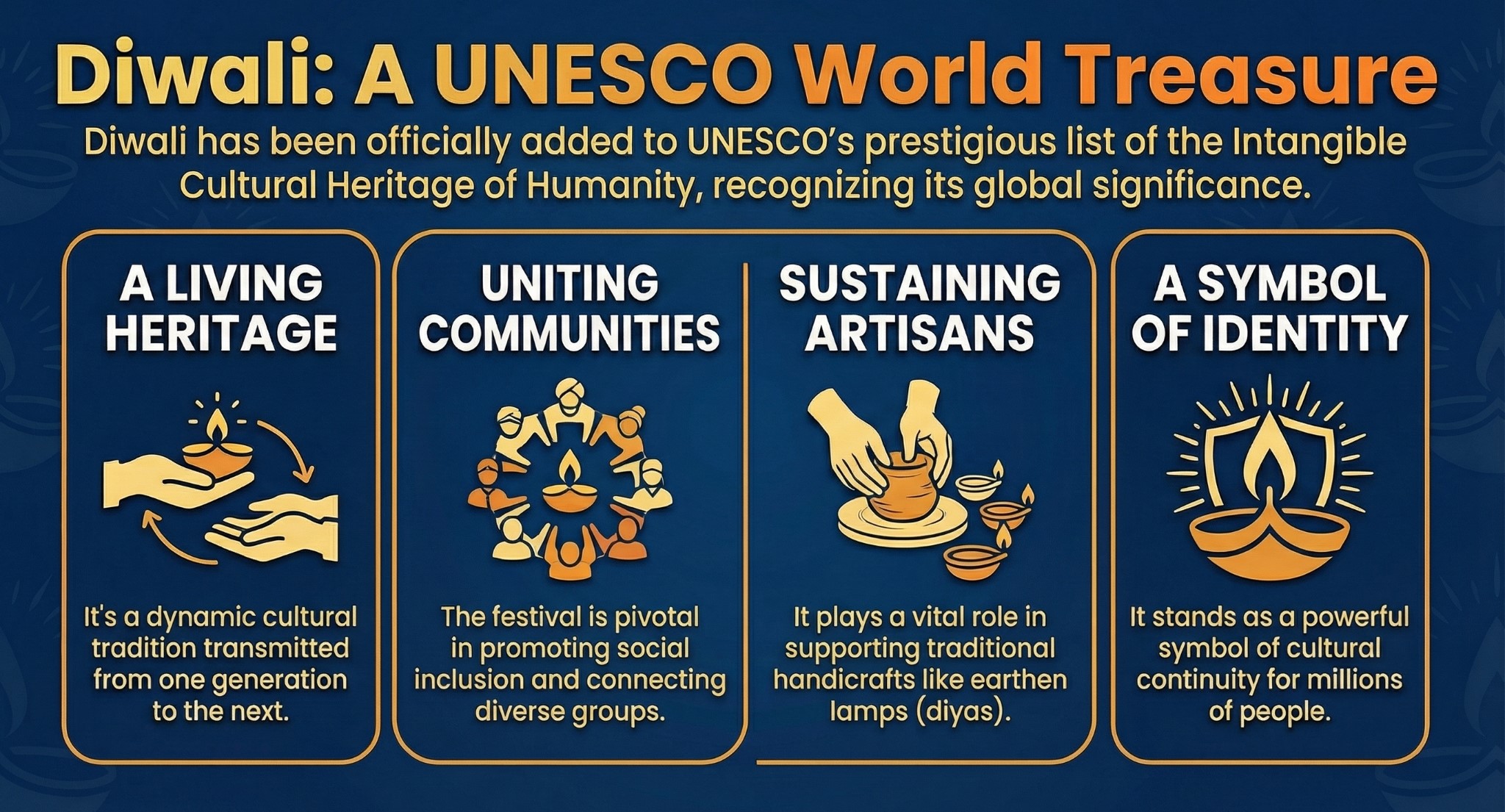
Central to UNESCO’s decision was the classification of Diwali as "living heritage." Unlike the static majesty of the Taj Mahal or the caves of Ajanta, which are protected as physical World Heritage Sites, Intangible Cultural Heritage (ICH) is defined by its dynamism. It exists in the minds, skills, and oral traditions of the people. Diwali fits this definition perfectly because it is transmitted from generation to generation not through textbooks, but through participation and observation.
The rituals of Diwali include the cleaning of homes to welcome the goddess Lakshmi, the drawing of intricate Rangoli patterns at the threshold, the preparation of specific sweets, and the oral recounting of the Ramayana are acts of cultural transmission. Grandparents teach grandchildren how to roll cotton wicks for oil lamps; mothers teach daughters the geometric precision of floor art. This intergenerational transfer ensures that the community’s collective memory is kept alive. The festival acts as a bridge between the ancient past and the modern present, proving that tradition is not an anchor holding society back, but a compass guiding it forward.
Weaving the Social Fabric: Cohesion and Inclusivity
One of the most compelling arguments in India’s nomination dossier was Diwali’s capacity to promote social inclusion. While deeply rooted in Hindu theology, commemorating the return of Lord Rama to Ayodhya, the festival has evolved into a pan-Indian cultural phenomenon that transcends religious lines. It is celebrated with equal fervor by Jains (marking Lord Mahavira’s nirvana), Sikhs (commemorating Bandi Chhor Divas), and Buddhists (honoring Emperor Ashoka’s conversion).
Beyond these theological connections, Diwali functions as a massive social lubricant. It is a time when old grievances are forgiven, and social hierarchies are temporarily blurred. The tradition of exchanging sweets and gifts with neighbors, regardless of their caste or creed, fosters a sense of community that is increasingly rare in urbanized societies. In rural India, the festival is a communal event where the entire village participates in lighting the streets and sharing resources. UNESCO’s recognition highlights this unifying power, presenting Diwali as an antidote to the isolation and fragmentation of the modern world. It underscores the festival’s role in creating a shared identity that binds the diverse populace of India together.
A Lifeline for Traditional Craftsmanship
Perhaps the most tangible impact of this recognition will be felt by the artisan communities of India. A key pillar of the Intangible Cultural Heritage convention is the protection of "traditional craftsmanship." Diwali is intrinsically linked to the livelihoods of millions of potters (Kumhars), weavers, and artisans. The quintessential symbol of the festival is the diya, a small earthen lamp that has been crafted on the potter's wheel for thousands of years.
In recent decades, the market for these traditional items has been threatened by the influx of mass-produced, industrial alternatives, such as cheap plastic LED lights and imported decorations. This shift not only eroded the aesthetic authenticity of the festival but also devastated the rural economy that depended on the seasonal spike in demand. The UNESCO inscription places a spotlight on these traditional crafts. By validating the "authentic" celebration of Diwali, it encourages a return to traditional, biodegradable, and handmade materials. This global attention validates the "Vocal for Local" sentiment, transforming the humble clay lamp from a commodity into a piece of global heritage. It offers a renewed sense of dignity and economic viability to the artisans whose skilled hands literally light up the nation.
India’s Cultural Constellation: A History of Recognition
Diwali’s entry into the list is the latest jewel in an already studded crown. India has been a proactive participant in the UNESCO ICH framework since the list's inception in 2008. The country has successfully inscribed 15 previous elements, creating a diverse portfolio of heritage.
The journey began with the inscription of Vedic Chanting and the Ramlila, showcasing India’s oral and performance traditions. Over the years, the list has expanded to include the Kutiyattam Sanskrit theatre of Kerala, the Chhau dance of Eastern India, and the Kalbelia folk songs of Rajasthan. More recently, India saw the inclusion of the Kumbh Mela, the world's largest peaceful congregation of pilgrims, and the Durga Puja of Kolkata, which was recognized for its artistic collaboration and public installation art. In 2023, the Garba dance of Gujarat was added, celebrating feminine energy and community dance.
Diwali’s addition completes a narrative arc. While other entries are often regional (like Durga Puja to Bengal or Chhau to the East), Diwali is truly national and international. It bridges the gap between the specific and the universal, representing the collective ethos of Indian civilization on the world stage.
The Challenge of Responsibility: The Way Forward
With great recognition comes great responsibility. The UNESCO tag is not a permanent laurel to rest upon; it requires the state party (India) to submit periodic reports on the status of the element and the measures taken to safeguard it. This brings the challenges facing modern Diwali into sharp focus, specifically the issues of commercialization and environmental degradation.
For the recognition to remain meaningful, the celebration of Diwali must align with sustainable practices. The rampant use of chemical firecrackers, which cause severe air and noise pollution, stands in direct contrast to the spiritual symbolism of "removing darkness." The UNESCO status provides a powerful platform for the government and civil society to advocate for a "Green Diwali." It legitimizes the argument that the true heritage of the festival lies in the light of the oil lamp, not the smoke of the firecracker.
Furthermore, there is a risk of "folklorization," where the festival is performed for tourists rather than lived by the community. Safeguarding measures must ensure that Diwali remains a community-led event. The government’s role should be to facilitate by providing clay to potters, ensuring spaces for community gatherings, and documenting the diverse oral traditions associated with the festival rather than controlling or sanitizing the celebration for a global audience.
Conclusion
The inscription of Diwali on the UNESCO Representative List of the Intangible Cultural Heritage of Humanity is a moment of immense pride and reflection. It is an affirmation that the values embodied by the festival like hope, knowledge, prosperity, and community are universal values cherished by humanity.
As the world looks at Diwali through this new lens, it sees more than just a holiday; it sees a resilient cultural system that has survived empires and eras. The recognition serves as a guardian for the future, ensuring that the glow of the diya continues to inspire generations to come, reminding us all that even the smallest light has the power to dispel the deepest darkness.