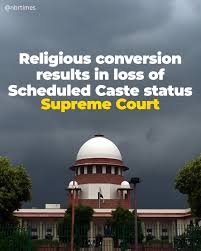
Scheduled Caste Status and Religious Conversion: Intersection of Faith and Social Identity
Scheduled Caste Status and Religious Conversion: Intersection of Faith and Social Identity
The Legal and Social Landscape of SC Status
In the complex tapestry of Indian jurisprudence, the intersection of religious identity and affirmative action remains one of the most debated subjects. Recently, the Supreme Court of India provided a significant legal clarification regarding the retention of Scheduled Caste (SC) status following religious conversion. This ruling addresses a fundamental question: does the social stigma and historical disadvantage associated with "untouchability" vanish when an individual adopts a new faith? By examining the recent judicial observations alongside the existing constitutional framework, we gain a clearer understanding of why the state maintains a link between specific religious affiliations and the eligibility for SC reservations. This discourse is not merely about administrative labels; it is about the fundamental definition of who qualifies for state-sponsored protection in a secular yet deeply stratified society.
The Supreme Court’s Definitive Ruling on Conversion
The core of the recent news revolves around the Supreme Court’s affirmation that converting from Hinduism, Sikhism, or Buddhism to religions such as Christianity or Islam results in the immediate and absolute loss of SC status. This loss is comprehensive, entailing the forfeiture of reservation benefits in educational institutions, government employment, and the specific legal protections provided under the Scheduled Castes and Scheduled Tribes (Prevention of Atrocities) Act. The Court’s rationale rests on the "Exclusivity of Status," noting that the legal definition of Scheduled Castes is historically and constitutionally tethered to faiths that arose within the Indian subcontinent and recognized the specific social disability of untouchability. By transitioning to a faith outside this designated group, the individual is legally viewed as having moved into a different social and theological category where the historical baggage of SC status no longer applies in the eyes of the law.
Theological Distinctions and the Consequence of Choice
A pivotal aspect of the Court’s observation is the "Theological Distinction" between Indic and Abrahamic faiths. The judiciary reasoned that religions like Christianity and Islam do not historically recognize or possess a structural mechanism of caste-based discrimination or "untouchability" within their core tenets. Since these religions are founded on principles of egalitarianism, the law assumes that a convert enters a community where the specific social "stain" of their former caste is erased. Furthermore, the Court highlighted the "Consequence of Choice." While Article 25 of the Constitution upholds the fundamental right to voluntary religious conversion, the exercise of this right carries legal weight. The transition out of the designated SC category is viewed as a conscious choice to adopt a new religious identity that, at least theoretically, does not acknowledge the caste hierarchy that necessitated reservations in the first place.
The Evolution of the 1950 Presidential Order
The legal backbone of this issue is the Constitution (Scheduled Castes) Order of 1950. Originally, this mandate was quite narrow, stating that only individuals professing the Hindu religion could be members of Scheduled Castes. However, as the political and social landscape evolved, so did the Order. In 1956, an amendment was passed to include the Sikh community, recognizing that many within that faith shared the same historical social disabilities. Later, in 1990, following the powerful Neo-Buddhist movement led by Dr. B.R. Ambedkar, the scope was expanded again to include Buddhists. These amendments demonstrate that the SC umbrella is not static, yet it remains firmly restricted to religions that have a documented historical relationship with the caste system’s internal dynamics. This evolutionary process underscores the state’s attempt to balance religious freedom with the targeted socio-economic upliftment of those most marginalized by the Hindu social order.
Judicial Precedents and the "Abandonment" of Customs
Indian courts have long grappled with the nuances of conversion through various landmark cases. For instance, in State of Kerala v. Chandramohanan (2004), the court established that a person ceases to be a member of a Scheduled Caste or Tribe upon conversion if they abandon their original customs and traditions in favor of their new faith. This focuses on the cultural and social shift that accompanies a change in religion. Similarly, in the older Soosai v. Union of India (1985) case, the Court upheld that the 1950 Order was not discriminatory against Christians. The justices argued then and the sentiment remains influential that there was insufficient evidence to prove that the specific social disabilities of "untouchability" persisted in the same form after an individual converted to Christianity. These precedents collectively reinforce the idea that conversion is a transformative legal act that resets one's relationship with state-provided caste benefits.
Challenges: Social Reality versus Theological Doctrine
Despite the clear legal stance, a significant debate persists regarding the "Social Reality" of converts. Critics and social activists argue for the "caste-follows-the-convert" theory, suggesting that while a religion may not theologically recognize caste, the surrounding society continues to treat the convert based on their ancestral roots. This argument posits that a "Dalit Christian" or "Dalit Muslim" often faces the same social exclusion and economic hardship as their Hindu counterparts, despite the change in their prayer books. This perspective was notably supported by the Ranganath Misra Commission in 2007, which recommended that SC status should be completely de-linked from religion, making it religion-neutral in the same way that Scheduled Tribe (ST) status is handled. The commission argued that social disability is a lived experience that does not necessarily vanish through the act of religious baptism or conversion.
The Path Toward Data-Driven Assessment and Legislative Clarity
The "Way Forward" in this contentious area relies heavily on objective, data-driven assessments. The Indian government has appointed several bodies, most recently the K.G. Balakrishnan Commission, to conduct an in-depth study of the socio-economic status of converts. The goal is to determine if these individuals still face the same historical handicaps and "untouchability-like" discrimination within their new religious communities. For any change to occur, legislative clarity is paramount. Any expansion of the SC umbrella would require a formal constitutional amendment by Parliament. This presents a complex challenge: lawmakers must balance the limited "quota pie" with the growing demands for inclusion from various marginalized groups. Until such a legislative shift happens, the judiciary's role is to ensure consistency, balancing the constitutional protection of religious freedom under Article 25 with the specific remedial objectives of the reservation system.
Conclusion: A Settled Principle in a Changing Society
The current legal standing of SC status and religious conversion serves as a reminder that in India, constitutional rights often operate at a delicate balance. The Supreme Court’s recent intervention reinforces the principle that SC status is not merely a social category but a legal one tied to specific historical and religious contexts. While the debate over the social persistence of caste in non-Indic religions continues to brew, the law currently views conversion as an exit from the specific social framework that reservations were designed to correct. Until legislative bodies decide to decouple religion from SC identity, a move that would require monumental political and social consensus, the loss of reservation benefits upon conversion remains a settled legal principle, reflecting the state's focus on the historical roots of "untouchability" as defined within the 1950 Presidential Order.