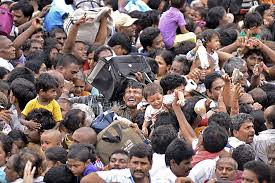
Stampedes in India
Stampedes in India
The tragic loss of life at the Shitala Mata temple in Bihar’s Nalanda District, where a sudden surge in a densely packed crowd resulted in eight fatalities, serves as a grim reminder of a persistent flaw in India’s public safety architecture. This incident is not an isolated anomaly but part of a distressing timeline that includes the 2024 Hathras tragedy, claiming over 121 lives, as well as historical disasters at the Prayagraj Kumbh and the New Delhi Railway Station. These events underscore a critical reality: in a nation defined by its vibrant mass gatherings, the transition from a celebratory assembly to a lethal crush is often separated by a thin margin of administrative oversight.
Each incident triggers a wave of national mourning and judicial inquiry, yet the fundamental patterns of these "man-made disasters" continue to repeat. The failure to institutionalize past lessons into a foolproof safety protocol suggests a gap between policy intent and ground-level execution. In the Indian context, where faith and festivities drive millions to specific geographical points simultaneously, the management of human density is not merely an administrative task; it is a life-saving science that demands the highest level of technical and psychological rigor.
Scale of the Problem: Mapping the Human Cost
The statistical magnitude of this issue is staggering and reveals a deep-seated vulnerability in the management of public spaces. According to historical data from the National Crime Records Bureau (NCRB), India has recorded over 4,000 stampede-related incidents in recent decades. Unlike natural disasters like earthquakes or cyclones, which are governed by unpredictable geological or atmospheric forces, stampedes are strictly categorized as anthropogenic or man-made disasters. This classification is vital because it implies that these events are inherently preventable through rigorous urban planning, architectural design, and psychological management.
The sheer frequency of these events in India, particularly at religious shrines and transit hubs, indicates a systemic failure to respect the physical limits of shared spaces. When thousands of individuals occupy a confined area, the physical laws of "fluid dynamics" take over. If the human flow is blocked or the density exceeds a critical threshold, typically more than four persons per square meter, the result is a catastrophic failure of safety. This often leaves the most vulnerable members of society, including women, children, and the elderly, at the highest risk of traumatic asphyxiation or mechanical crush injuries.
Structural and Administrative Root Causes
The genesis of a stampede is rarely a single event but rather a cascading failure of multiple intersecting systems. At the core is a profound lack of specialized expertise in scientific crowd management. In many Indian districts, the responsibility for managing millions of people falls on local police personnel who are trained in traditional law enforcement, primarily "lathi-charge" or reactive force rather than the subtle art of crowd psychology and "force mitigation."
Furthermore, India’s pervasive "VIP Culture" acts as a physical hazard. When large, strategic swathes of a venue are cordoned off for dignitaries, the general public is compressed into the remaining narrow corridors, creating artificial and dangerous bottlenecks. Infrastructure deficits exacerbate this issue; many historical temples and railway platforms were designed centuries ago and feature narrow approach roads, slippery stone floors, and a total absence of designated emergency exits. These physical constraints turn a high-density area into a "death trap" where any minor disturbance, be it a stumble or a push can trigger a lethal chain reaction that is impossible to halt once initiated.
Psychological and Environmental Triggers of Chaos
Beyond the physical infrastructure, the psychological state of a crowd is the primary detonator of a stampede. Rumors are perhaps the most dangerous catalyst in a high-stress environment. A single false shout about a collapsing bridge, a terrorist threat, or a short circuit can induce "mass panic," leading to a desperate, irrational rush for perceived safety. This is often fueled by the "Fear of Missing Out" (FOMO), a phenomenon where devotees or fans push forward aggressively to ensure they catch a glimpse of a deity or a celebrity before a specific ritual ends or a gate closes.
Environmental factors also play a critical role in escalating tension. Poor lighting can increase collective anxiety and hide tripping hazards, while technical failures like a minor electrical spark in a congested area can cause a surge in a specific direction. In these moments, individual agency is lost to "herd behavior." People move as a single, pressurized mass, often unaware that their collective forward momentum is causing those at the front of the "wave" to suffocate against barriers or be trampled underfoot. This "crowd turbulence" is a physical phenomenon where the force of the crowd becomes greater than the strength of the individuals within it.
Mitigation Strategies: The Shift to Scientific Planning
To effectively curb this crisis, India must move away from "crowd control" (which is reactive and often involves force) toward "crowd management" (which is proactive and based on data). One of the most effective tools is the implementation of scientific queuing patterns. Zigzag or "S-shaped" queues are specifically designed to break the linear force of a moving crowd. By forcing the crowd to change direction frequently, the build-up of "crowd crush" pressure is naturally dissipated.
Additionally, "Capacity Mapping" must become a non-negotiable prerequisite for any public event. This involves using software or manual surveys to pre-calculate the maximum safe occupancy of a venue based on square footage and available exits. Administrators must strictly halt entry once that threshold is reached, regardless of the social or political pressure to allow more people in. By treating the crowd as a fluid that requires specific flow rates and "holding tanks" (waiting areas), officials can prevent the dangerous density levels that lead to physiological distress.
Infrastructure, Communication, and Digital Oversight
Modern technology offers a suite of solutions that can bridge the gap in human oversight. Drone surveillance is now a critical asset, providing real-time aerial heatmaps that identify "hotspots" of overcrowding before they reach a breaking point. On the ground, infrastructure must be redesigned to ensure that exit routes are significantly wider than entries and are never obstructed by vendors or temporary barricades.
Communication is equally vital for maintaining order. The aggressive and strategic use of Public Address (PA) systems and large information screens can provide "calming messages" and clear, non-conflicting directions. This is the most effective way to neutralize the spread of lethal rumors. Furthermore, "May I Help You" desks staffed by trained, multi-lingual volunteers can act as local anchors of stability. These stations guide confused attendees and prevent the "cross-flow" of human traffic—where two groups of people try to move through each other in opposite directions—which is a primary cause of turbulence and falls within a crowd.
Training, Sensitization, and the Policy Framework
The ultimate success of any safety protocol rests on the individuals tasked with its execution. There is an urgent need for mandatory, specialized crowd management training for police and National Disaster Response Force (NDRF) teams. This training should be conducted every three to four months to ensure readiness for diverse seasonal or festival-specific scenarios.
Training must include "soft skills" and sensitization; a polite, approachable police presence is far more effective at keeping a crowd calm and cooperative than an aggressive, stick-wielding force that may inadvertently trigger a panic-driven flight response. This approach is firmly supported by the National Disaster Management Authority (NDMA) Guidelines of 2014, which provide a comprehensive blueprint for managing mass gatherings at places of worship. Legally, the proactive application of Section 144 of the CrPC can help regulate assembly sizes, provided it is utilized as a safety-enabling tool rather than a restrictive political measure. Central to this framework is the accountability of the District Magistrate (DM) and Superintendent of Police (SP) to conduct joint safety audits before any large-scale event.
Conclusion: Prioritizing the Sanctity of Life
Stampedes in India are a stark and tragic reminder of the gap between our immense capacity for mass mobilization and our current commitment to public safety. While large-scale religious and cultural gatherings are the heartbeat of Indian social and spiritual life, their continued occurrence in an unsafe manner is an affront to the fundamental Right to Life guaranteed under Article 21 of the Constitution.
The transition from reactive policing to a proactive, technology-driven, and scientifically-informed disaster mitigation strategy is no longer optional, it is a moral and legal imperative. By adhering to the "Safety First" principle and treating every large gathering as a high-stakes logistical operation, we can ensure that the spiritual fervor of our citizens does not end in preventable tragedy. We must collective ensure that a "Fear of Missing Out" never again results in a "Fear of Losing Life." The sanctity of the devotee must be matched by the safety of the venue.