The 2026 India–US Trade Reset: A Strategic and Energy Paradigm Shift
The 2026 India–US Trade Reset: A Strategic and Energy Paradigm Shift
On February 2, 2026, the global geopolitical landscape witnessed a tectonic shift as Indian Prime Minister Narendra Modi and U.S. President Donald Trump announced a comprehensive trade agreement. This announcement came after a period of intense diplomatic friction, during which the United States had imposed cumulative tariffs reaching up to 50% on Indian exports. The resolution of this "mini-trade war" marks a pivotal moment, signaling a move toward deep economic interdependence. The deal is not merely a reduction in taxes but a profound realignment of India’s energy security and strategic positioning in the Indo-Pacific. By de-escalating tensions, the two largest democracies have set the stage for a partnership that could define the economic order of the mid-21st century.
Understanding the Tariff Breakthrough
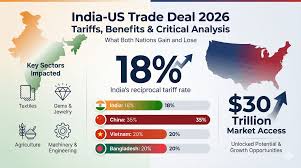
The most immediate outcome of the 2026 deal is the drastic reduction of trade barriers. Since August 2025, many Indian goods were burdened by a "twin-tariff" structure: a 25% base reciprocal tariff and an additional 25% "Russian oil penalty." The new agreement slashes this effective 50% rate down to 18% for most Indian products. This 18% figure is strategically significant; it places India at a competitive advantage over regional peers like Vietnam and Bangladesh, who face tariffs in the 19–20% range. For Indian sectors such as textiles, gems and jewelry, and engineering goods, which operate on thin margins, this 32-point reduction acts as a vital lifeline, restoring the predictability required for long-term industrial investment.
Mission 500 and the $500 Billion Commitment
A cornerstone of the agreement is the ambitious "Mission 500" initiative. Under this framework, India has committed to purchasing over $500 billion worth of U.S. goods and services by 2030. This includes massive outlays for American energy (LNG and coal), advanced technology, and defense equipment. From the American perspective, this addresses long-standing trade deficit concerns. For India, it serves as a mechanism to modernize domestic infrastructure while securing a "Most Favored Nation" status in practice. While some economists view the $500 billion figure as an aspirational goal given current import levels, the intent signals a "Buy American" pivot that replaces older, non-aligned procurement strategies.
The Energy Pivot: From Russia to the Americas
A sensitive aspect of the deal is India’s agreement to scale back, and eventually halt, its reliance on Russian crude oil, which had accounted for over one-third of its imports. The U.S. made the cessation of these imports a condition for removing the 25% penal tariff. To fill this vacuum, India is pivoting toward American shale and potentially Venezuelan crude. This shift is not merely a change in vendors but a total overhaul of India’s energy logistics. By diversifying away from the Russian "Urals" grade, India is attempting to insulate itself from Western sanctions while aligning its energy security with the Quad’s strategic objectives.
Technical Hurdles in the Refinery Landscape
The transition toward Venezuelan crude presents a formidable technical challenge. Venezuelan oil (such as the "Merey" grade) is notoriously "bottom-heavy," meaning it is thick, has high viscosity, and contains significant concentrations of metals (vanadium/nickel) and nitrogen. Most Indian state-owned refineries were designed for lighter, "sweeter" crudes. Subjecting these older facilities to heavy, acidic Venezuelan oil carries a high risk of equipment corrosion and catalyst poisoning unless the oil is co-blended with lighter crudes (typically in a 10–15% range). Consequently, private players like Reliance Industries and Nayara Energy, which possess high-complexity refineries (Nelson Complexity Index of 12–21), are better positioned to handle these difficult grades.
Market Euphoria and the Adani Factor
The trade deal triggered an explosive rally in Indian equity markets on February 3, 2026. Among the most prominent beneficiaries were the stocks of the Adani Group, with companies like Adani Enterprises and Adani Green Energy seeing surges between 7% and 13%. This reaction is attributed to the group's massive footprint in port infrastructure, logistics, and renewable energy, sectors directly impacted by the tariff cuts. Specifically, the reduction in duties on solar cells and modules significantly enhances the cost-competitiveness of Indian-made renewable equipment in the U.S. market, which has emerged as India's most important overseas destination for clean energy tech.
Domestic Dissent and Political Controversies
Despite the economic optimism, the deal has ignited a firestorm of political controversy. Opposition leaders have characterized the agreement as a "complete surrender," alleging that the Prime Minister signed under duress. Concerns persist regarding the agricultural sector; farmer unions fear that "zero-tariff" access for U.S. dairy and poultry products could devastate the livelihoods of small-scale Indian farmers. Furthermore, critics argue that the shift in oil policy represents a "surrender" of strategic autonomy, potentially straining India's long-standing relationship with Russia in exchange for temporary trade relief.
Conclusion: A Balancing Act for Sovereignty
The 2026 India–US trade deal represents a high-stakes gamble for New Delhi. On one hand, it provides the "Made in India" initiative with an unprecedented competitive edge in the world's largest consumer market. On the other, it demands a significant sacrifice in energy procurement and risks domestic social unrest in sensitive sectors like agriculture. As implementation begins, the true test will be whether India can upgrade its technical refining capacity and protect its domestic interests while fulfilling its $500 billion promise. Ultimately, the success of this deal will be measured by India's ability to remain a global power without becoming economically tethered to a single partner.