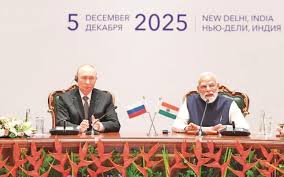
The 23rd India–Russia Annual Summit: Recalibrating a Time-Tested Partnership for a Multipolar Era
The 23rd India–Russia Annual Summit: Recalibrating a Time-Tested Partnership for a Multipolar Era
The geopolitical landscape of the 21st century has been defined by rapid shifts in power dynamics, fluctuating alliances, and an increasingly complex global security architecture. Yet, amidst this flux, the relationship between New Delhi and Moscow has remained a study in constant flux. The recently concluded 23rd India–Russia Annual Summit was not merely a diplomatic formality; it was a watershed moment that marked the completion of 25 years of the "Strategic Partnership" established in 2000. As the leaders of both nations convened to review bilateral ties, the atmosphere was one of ambitious forward-looking planning, aiming to insulate their cooperation from external geopolitical shocks.
The summit concluded with a comprehensive joint statement that reaffirmed the "Special & Privileged Strategic Partnership," a designation that sets this relationship apart in the hierarchy of global diplomacy. Against the backdrop of a polarizing global order, the 2025 summit served as a critical platform to recalibrate ties for the next decade. The adoption of "Programme 2030" and the signing of critical agreements across defense, energy, and connectivity signal that India and Russia are preparing to navigate the challenges of a multipolar world together, moving beyond traditional buyer-seller dynamics toward a more integrated, co-dependent alliance.
A Milestone in Diplomatic History: Reaffirming Trust
The 2025 Summit held special significance as it commemorated the silver jubilee of the formal Strategic Partnership. This quarter-century journey has seen the relationship mature from one rooted in Cold War-era nostalgia to a pragmatic partnership driven by strong convergence on core national interests. The joint statement released at the conclusion of the summit emphasized that this bond is "time-tested" and "trust-based." In the world of international relations, where interests often supersede friendships, the resilience of India-Russia ties is attributed to a mutual respect for each other's strategic autonomy and core concerns.
The leaders utilized this platform to articulate a shared vision for a multipolar global order. Both nations have long advocated for a reformed international architecture that reflects contemporary realities rather than post-WWII power structures. This ideological alignment forms the bedrock of their diplomatic engagement, allowing them to support each other on multilateral platforms despite external pressures. The reaffirmation of this shared worldview suggests that New Delhi and Moscow intend to continue coordinating their positions to act as stabilizing forces in global geopolitics, resisting unilateralism and promoting a balanced distribution of global power.
Charting a New Economic Course: Programme 2030
One of the most substantial outcomes of the summit was the adoption of Programme 2030, a comprehensive roadmap designed to anchor the relationship in economic depth. Historically, the India-Russia partnership has been criticized for being "top-heavy", strong on political and defense cooperation but relatively weak on trade and economics compared to other major powers. This summit sought to correct that imbalance with an ambitious target: achieving USD 100 billion in bilateral trade by 2030.
To realize this goal, the two nations addressed the financial mechanisms of trade directly. In an era where currency weaponization is a tangible risk, India and Russia took decisive steps to insulate their economic exchanges. The decision to deepen trade settlement using national currencies (the Rupee and the Ruble) is a strategic maneuver to bypass third-party currency fluctuations and sanctions. Furthermore, the commitment to ensure the interoperability of payment systems and explore the use of Central Bank Digital Currencies (CBDCs) places the partnership at the cutting edge of financial technology. These measures are expected to streamline cross-border transactions, reduce costs for exporters, and provide a stable framework for long-term commercial engagement, ensuring that economic ties are not held hostage by external banking sanctions.
Redefining Defense Cooperation: The 'Make in India' Imperative
Defense has historically been the strongest pillar of India-Russia cooperation, but the 23rd Summit marked a definitive shift in the nature of this engagement. Moving away from the traditional "buyer-seller" model, which dominated the previous decades, the two sides committed to a framework of joint research and development (R&D), co-development, and co-production. This transition aligns perfectly with India’s "Make in India" initiative, transforming the country from a mere importer of hardware into a hub for defense manufacturing.
The joint statement highlighted specific support for spare-part manufacturing in India for Russian-origin equipment. This is a critical development for the Indian armed forces, which operate a vast inventory of Russian platforms; domestic manufacturing of spares ensures higher operational readiness, reduced downtime, and strategic self-reliance. Additionally, the summit underscored the continued importance of military interoperability through exercises like INDRA-2025 and trilateral training formats. By integrating their defense industries and supply chains, India and Russia are effectively "future-proofing" their military relationship against external disruptions, ensuring that defense cooperation remains a pillar of stability.
Energy Security: The Backbone of Bilateral Ties
If defense is the shield of the partnership, energy is arguably its lifeblood. The summit saw a significant expansion of the energy portfolio, extending beyond simple crude oil imports to a more diversified basket of collaboration. The leaders agreed to strengthen ties in Oil, Gas, LNG, Petrochemicals, and Coal Gasification. This diversification is crucial for India’s energy security, ensuring a steady flow of resources to fuel its rapidly growing economy while offering Russia a reliable long-term market.
A notable addition to the energy dialogue was the focus on the long-term supply of fertilizers. Given the volatility in global agricultural markets and the critical importance of food security for India’s vast population, securing a reliable supply of fertilizers from Russia is a strategic win. Furthermore, the agreement to fast-track pending investment issues signals a willingness to remove bureaucratic hurdles that have previously stalled energy projects. This renewed focus ensures that the energy bridge between the two nations remains robust, insulating both economies from global price shocks and supply shortages.
Strategic Connectivity: Bridging the Geopolitical Divide
Connectivity emerged as a central theme of the summit, driven by the need to create reliable trade routes that are immune to geopolitical blockades. The joint statement reflected a strong commitment to scale up infrastructure for three critical corridors: the International North-South Transport Corridor (INSTC), the Chennai–Vladivostok Maritime Corridor, and the Northern Sea Route (Arctic).
The INSTC is particularly significant as it offers a shorter, cheaper route connecting India to Russia via Iran, bypassing traditional volatile routes. Simultaneously, the focus on the Arctic and the Vladivostok corridor highlights a new frontier in cooperation—the Russian Far East. By collaborating on these routes, the two nations are not just building roads and ports; they are reshaping the logistics map of Eurasia. This connectivity push is essential for realizing the trade targets set under Programme 2030, as efficient logistics are the prerequisite for sustained economic exchange.
Frontiers of Science: Nuclear, Space, and Skilled Mobility
Beyond terrestrial concerns, the summit also focused on high-technology collaboration in nuclear energy and space. Progress on the Kudankulam Nuclear Power Plant (NPP) units was reviewed, with discussions extending to a potential second nuclear site in India. The collaboration aims to deepen engagement in nuclear fuel cycles, localization of components, and advanced reactor technology, cementing Russia's position as India's primary partner in civil nuclear energy.
In the space sector, the partnership between ISRO and Roscosmos was elevated to include cooperation on human spaceflight, satellite navigation, and the development of rocket engines. This synergy allows both nations to leverage each other's technological strengths in the competitive race for space exploration. Furthermore, recognizing the importance of human capital, a Skilled Mobility Agreement was signed to facilitate the regulated movement of Indian skilled workers to Russia. This agreement addresses labor market needs and fosters people-to-people ties, adding a human dimension to the strategic partnership.
Conclusion
The 23rd India–Russia Annual Summit reinforced the depth and resilience of the bilateral partnership. It successfully navigated the complexities of the current geopolitical environment by focusing on tangible, long-term outcomes. With the adoption of Programme 2030 and new agreements across defense, energy, nuclear, connectivity, and skilled mobility, the summit sets a long-term trajectory for strategic cooperation.
Both nations continue to align on key global issues, from UNSC reforms to counter-terrorism, reaffirming the partnership’s relevance. By transitioning from a transactional relationship to one based on joint production, connectivity, and economic integration, India and Russia have demonstrated that their "Special & Privileged Strategic Partnership" is not a relic of the past, but a dynamic framework built for the future.