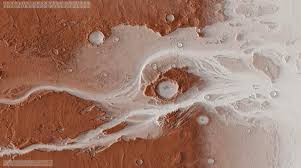
The Echo of Ancient Waters: Unveiling the Secrets of Paraná Valles on Mars
The Echo of Ancient Waters: Unveiling the Secrets of Paraná Valles on Mars
The history of Mars is written in its scars. For centuries, astronomers gazed at the Red Planet, speculating about the canals and waterways that might crisscross its rusty surface. While the romantic notion of alien-constructed canals has long been debunked, the reality that modern science has uncovered is far more profound. Mars was not always a desolate, frozen desert. It was once a world of dynamic, flowing chaos—a blue marble that arguably mirrored Earth. In a significant advancement for planetary science, researchers have recently completed a comprehensive mapping of extensive river drainage systems on Mars, identifying 16 major ancient basins. Among these discoveries, one geological feature has emerged as the definitive "smoking gun" of the planet's aquatic past: the massive fluvial system known as Paraná Valles.
The Geography of a Lost World
To understand the magnitude of Paraná Valles, one must first appreciate the canvas upon which it is etched. The system is situated in the Martian southern hemisphere, specifically within a region known as Margaritifer Terra. To the untrained eye, Margaritifer Terra is a chaotic landscape of craters and fractures, an ancient highland that bears the heavy pockmarks of the Late Heavy Bombardment era. However, to a geologist, this region is a treasure trove. It is geologically distinct due to its high concentration of valley networks and water-related landforms, serving as a preservation ground for the planet's hydrological history.
Paraná Valles is not merely a dried-up creek or a small tributary; it is a colossal drainage system. The recently concluded mapping study reveals that the drainage basin covers a watershed area exceeding 100,000 square kilometers. To put this into a terrestrial perspective, this scale meets the threshold used by hydrologists to classify "large river systems" on Earth. It rivals the catchment areas of some of our planet's significant rivers, suggesting that the volume of water required to carve such features was not a trickle, but a torrent. This was a system that dominated the landscape, likely functioning as a primary artery for water transport across the southern highlands, moving vast quantities of liquid and sediment over geological timescales.
The Dendritic Fingerprint: Evidence of Rainfall
The most scientifically compelling aspect of Paraná Valles lies in its specific morphology. When water shapes land, it leaves a signature that tells us how the water arrived there. On Mars, many valleys were formed by groundwater sapping, where the ground collapses due to water flowing beneath it or by sudden, catastrophic floods from melting ice. However, Paraná Valles is different. The valley network exhibits a "dendritic" drainage pattern. Derived from the Greek word dendron, meaning tree, this pattern is characterized by a branching structure where smaller tributaries feed into larger streams, which in turn feed into main river channels, resembling the veins of a leaf.
On Earth, dendritic patterns are almost exclusively formed by precipitation. They occur when rain or snow falls across a broad area, collecting in swales and gullies that eventually merge to form rivers. The presence of such a clear, widespread dendritic network at Paraná Valles provides some of the strongest geological evidence to date that ancient Mars possessed a stable, precipitation-based climate. It suggests that the Red Planet was not just wet underground, but that it had an active water cycle: evaporation from water bodies, the formation of clouds in a thick atmosphere, and rainfall that washed over the highlands. This finding challenges the "Cold and Icy" Mars theory and lends significant weight to the "Warm and Wet" hypothesis, painting a picture of a planet that may have experienced monsoon-like seasons billions of years ago.
The Mechanics of Erosion and Sediment Transport
The formation of a system as complex as Paraná Valles was not an overnight event. It was the result of a prolonged geological epoch during which Mars possessed a warmer and wetter climate. The mapping of the basin reveals the intricate mechanics of erosion that took place. As rainfall-fed surface runoff moved across the Margaritifer Terra, it stripped away the regolith (soil), carving deep V-shaped valleys into the crust. But the water did more than just destroy; it also built.
Rivers are the great movers of planetary material. As the waters of Paraná Valles flowed, they carried massive loads of sediment like sand, silt, and clay downstream. The study of this region has identified distinct sedimentary channels and deposits that confirm a history of sediment transport. The flow path likely traversed through a series of interconnected valleys and open lakes, creating a dynamic environment where water slowed down and sped up, depositing layers of mud and minerals. These sedimentary archives are crucial because they imply that the water–rock interaction was sustained. This was not a flash flood that vanished in a week; it was a persistent river system that likely flowed for thousands or millions of years, chemically altering the rocks it touched and creating clays that can only form in the presence of long-standing liquid water.
Connection to the Ancient Martian Ocean
Where did all this water go? The mapping of Paraná Valles provides clues that link the highlands of the south to the lowlands of the north. The flow direction and topography suggest that the water traversing this massive system eventually drained into larger canyon systems. Many planetary scientists hypothesize that these discharge channels fed into a vast, ancient ocean that once covered the northern hemisphere of Mars, often referred to as the "Oceanus Borealis."
Paraná Valles, therefore, acts as a critical puzzle piece in reconstructing the global hydrology of ancient Mars. If this drainage system was indeed a tributary to a northern ocean, it implies a fully integrated planetary hydrosphere. It suggests a world where water evaporated from the ocean, traveled as clouds over the southern highlands, fell as rain, and returned to the sea through river systems like Paraná Valles. This cyclical movement of water is the heartbeat of a living planet. By mapping the full extent of this basin, scientists are effectively tracing the arteries of a dead world, reconstructing a circulatory system that ceased to function billions of years ago when the Martian atmosphere was stripped away by solar winds.
A Beacon for Astrobiology and the Search for Life
While the geological implications are fascinating, the biological implications of Paraná Valles are profound. The search for extraterrestrial life is, fundamentally, a search for water and energy. Paraná Valles had both. Large river systems are engines of biological potential because they facilitate the mixing of nutrients. As water flows over land, it dissolves minerals like iron, magnesium, sulfates and concentrates them in riverbeds and deltas.
For astrobiologists, this makes Paraná Valles a high-priority target. The sedimentary deposits within the basin represent arguably the best-preserved library of Martian history. If microbial life existed in the waters of ancient Mars, it likely thrived in the nutrient-rich environments created by this river system. When these microbes died, they would have been buried in the soft sediments, potentially fossilizing into biosignatures. Unlike the surface rocks that have been sterilized by billions of years of ultraviolet radiation, the deep sedimentary layers of Paraná Valles could protect organic compounds. Therefore, this region is not just a monument to past water; it is a potential graveyard of ancient biology, waiting for future rovers or human explorers to exhume its secrets.
Conclusion: The Legacy of a Dry River
The mapping of Paraná Valles serves as a stark reminder of the fragility of planetary environments. It tells the story of a world that was once strikingly similar to our own, capable of sustaining rain, rivers, and perhaps even life, before transforming into the harsh desert we see today. As humanity stands on the precipice of becoming an interplanetary species, understanding systems like Paraná Valles is essential. It helps us characterize the resources available for future colonization specifically, where to look for hydrated minerals and it guides the philosophical quest to understand our place in the universe. The rivers of Mars may have run dry billions of years ago, but through the lens of modern science, Paraná Valles flows again, offering a stream of data that continues to nourish our understanding of the cosmos.