The Israel-Iran Conflict and the 2026 Global Energy Crisis
The Israel-Iran Conflict and the 2026 Global Energy Crisis
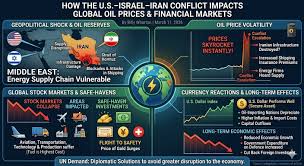
The geopolitical landscape of West Asia underwent a seismic shift in early 2026, transitioning from a decades-long "shadow war" of proxy engagements to a direct, high-intensity industrial conflict. This escalation has moved beyond traditional military objectives, evolving into a systemic "Energy War" targeting the economic foundations of regional powers. The immediate fallout has been a historic disruption to global commodity markets, with Brent crude prices breaching $115–$119 per barrel and European natural gas futures surging by over 30% in mid-March. As the conflict intensifies, the world faces an unprecedented energy crunch that threatens to destabilize global inflation targets, food security, and the fragile post-pandemic economic recovery.
The Strategic Shift: Targeting the Economic Lifeblood
The turning point occurred on March 18, 2026, when Israel executed a massive airstrike on Iran’s South Pars gas field. As the world’s largest natural gas deposit shared between Iran and Qatar, South Pars is the primary pillar of the Iranian economy. Historically, Israeli operations focused on nuclear facilities or IRGC command structures. However, this "Upstream Strike" on the Asaluyeh processing hub signaled a new doctrine: the systematic dismantling of an opponent's economic capacity. By taking offline approximately 14% of South Pars' output (100 million cubic meters per day), Israel aimed to generate internal pressure through electrical blackouts and factory closures, effectively treating industrial infrastructure as a primary military target.
Iranian Retaliation and the "Hormuz Stranglehold"
In a swift response, the Iranian Revolutionary Guard Corps (IRGC) abandoned "strategic patience" and declared "zero restraint" regarding future strikes. Tehran shifted its focus to the energy assets of U.S. allies, launching drone and missile swarms that damaged Qatar’s Ras Laffan Industrial City, wiping out nearly 17% of its LNG capacity for what experts suggest could be a three-to-five-year repair period. Similar strikes hit Kuwait's Mina Al-Ahmadi refinery and Saudi Arabia's Red Sea facilities. Simultaneously, Iran effectively restricted traffic through the Strait of Hormuz, a passage through which 20% of the world's oil and LNG flows, holding the global economy hostage to force international intervention.
Global Energy Vulnerability and Market Volatility
The "Energy War" has exposed the fragile nature of global supply chains. Europe, still sensitive after decoupling from Russian gas, faced a renewed crisis as Asian and European benchmark prices skyrocketed by 40% and 50% respectively following the Ras Laffan attack. Insurance giants like Lloyd's of London have imposed war-risk exclusions on Gulf infrastructure, causing shipping premiums to multiply tenfold. In the Asian theater, major economies including India, Japan, and South Korea, which account for the vast majority of the region's exports are grappling with supply shocks. This volatility has led to industrial rationing and fears of a global recession, as energy costs erode consumer spending and manufacturing competitiveness.
The Expanding Food Security Crisis
The repercussions have bled into the global agricultural sector, triggering a secondary crisis in food security. The Strait of Hormuz is a transit point for 25% of the world’s fertilizer production. With the maritime blockade and strikes on petrochemical hubs, fertilizer costs have surged, directly impacting planting seasons in global breadbaskets. This disruption is particularly devastating for import-dependent regions in Africa and Southeast Asia. British think tanks have warned that these second-round effects could push global inflation significantly higher, as rising fuel and fertilizer costs are historically precursors to social unrest and political instability in developing nations.
Diplomatic Friction and the "Strategic Daylight"
The conflict has created a complex rift between Washington and Jerusalem. While the Trump administration initially signaled support for degrading Iran's military capabilities, the specific strike on the South Pars field and the subsequent threat to Qatari energy created "strategic daylight." President Trump claimed the U.S. "knew nothing" of the South Pars strike and publicly warned Prime Minister Netanyahu to refrain from further infrastructure attacks. However, Israeli officials disputed this, claiming coordination had occurred. Washington now faces the dilemma of supporting a key ally while threatening "massive retaliation" against Iran if it continues to target the assets of neutral partners like Qatar, revealing deep fissures in the U.S.-Israel strategic partnership.
India’s Vulnerability and Emergency Domestic Measures
India is among the most impacted nations, relying on the Gulf for 50% of its crude oil and over 90% of its LPG. In response, the Indian government invoked the Essential Commodities Act and issued the Natural Gas (Supply Regulation) Order, 2026. These emergency measures prioritize household LPG and essential sectors like hospitals over industrial use. Refineries have been directed to maximize LPG production by diverting all propane and butane streams to the domestic pool, resulting in a 25% increase in domestic production. To prevent hoarding, the government increased the minimum gap between LPG bookings to 25 days in urban areas and 45 days in rural regions, while expanding Delivery Authentication Code (DAC) coverage to 90%.
Strategic Neutrality and the "Russian Buffer"
Despite economic pressure, India has maintained a policy of "Strategic Balancing." While co-sponsoring a UNSC resolution condemning Iranian attacks on neutral Gulf infrastructure, New Delhi has maintained open channels with all parties, including Tehran. To mitigate the Gulf crisis, the U.S. Treasury issued a 30-day waiver in March 2026, allowing Indian refiners to purchase Russian oil currently stranded at sea. Simultaneously, India activated Operation Sankalp, deploying naval assets to escort Indian-flagged tankers through the Gulf of Oman. Through these measures combined with a new agreement for 2.2 million tonnes of U.S. LPG, India is attempting to shield its 33 crore households from the worst of the "geoeconomic firestorm."
A Test for the "Act West" Policy
The 2026 Israel-Iran conflict has fundamentally altered the rules of engagement in West Asia, turning energy infrastructure into the primary theater of war. For India, this crisis is the ultimate test of its "Act West" and "Multi-alignment" policies. The nation must perform a high-stakes balancing act: securing its immediate energy needs through rigid domestic controls and strategic imports while navigating a fragmented global diplomatic landscape to prevent a total collapse of the regional security architecture. As the world watches the "Hormuz Stranglehold," it is becoming clear that a regional "Energy War" has toxic, borderless repercussions for the global economy.