India Achieves Near-Universal Banking Coverage: A Milestone in India's Financial Inclusion Journey
India Achieves Near-Universal Banking Coverage: A Milestone in India's Financial Inclusion Journey
Introduction
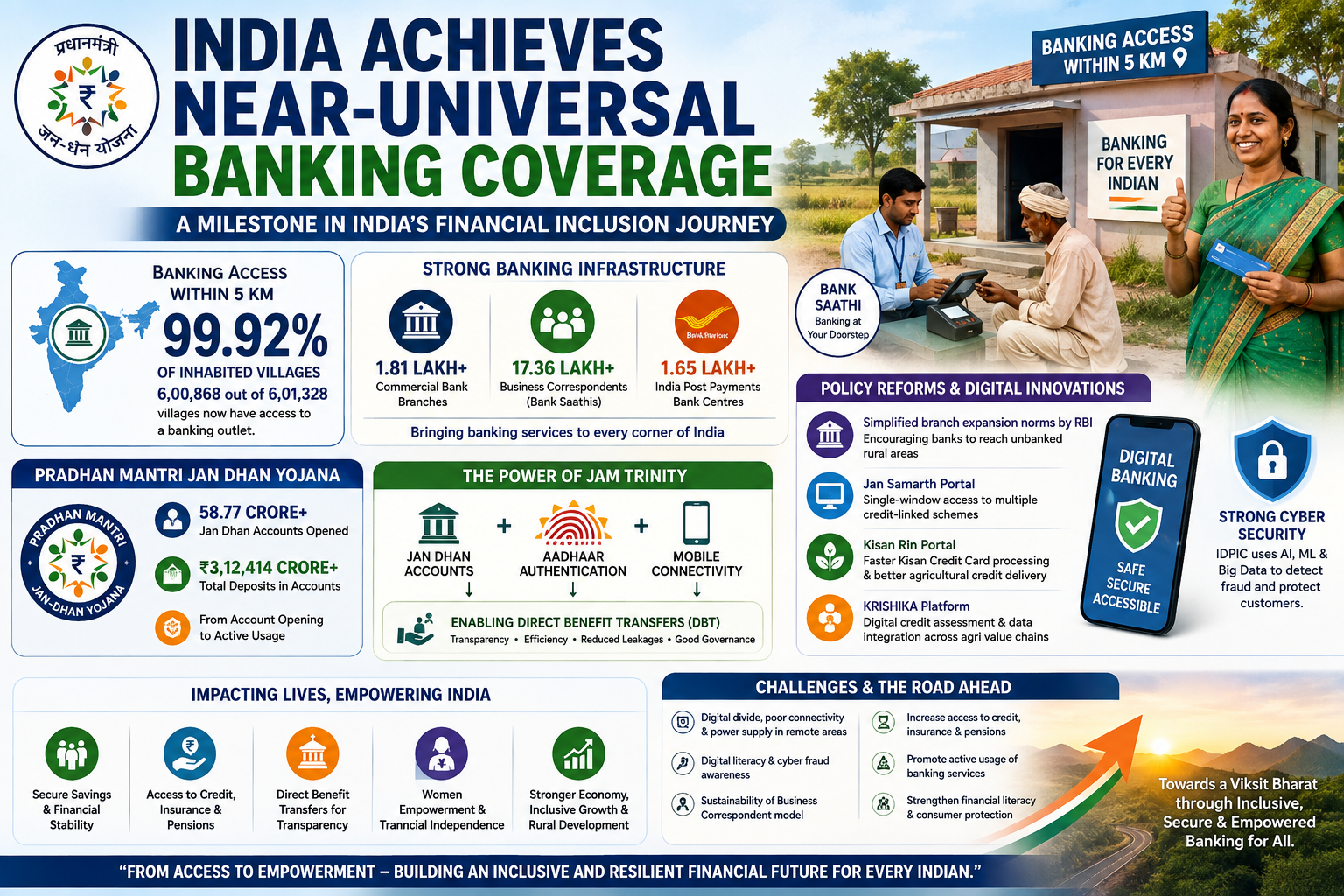
India has reached a historic milestone in its journey toward inclusive economic development by achieving near-universal banking coverage across the country. According to data available on the Jan Dhan Darshak (JDD) portal, 99.92% of India's inhabited villages (6,00,868 out of 6,01,328), now have access to a formal banking outlet within a radius of five kilometres. This achievement reflects the success of the country's long-term strategy of combining physical banking infrastructure, digital technology, policy reforms, and financial inclusion initiatives. It also demonstrates how the government, financial institutions, and technology platforms have collectively transformed banking from an urban-centric service into an essential public utility accessible even in remote and underserved regions.
While universal banking access is a significant accomplishment, the next stage of financial inclusion lies in ensuring meaningful financial participation through credit, insurance, pensions, and digital financial services. Thus, this achievement represents not the end of the journey but the foundation for a more inclusive and resilient financial ecosystem.
Banking Infrastructure: Building the Foundation of Financial Inclusion
The expansion of India's banking infrastructure has played a decisive role in achieving near-universal banking coverage. The country currently has more than 1.81 lakh commercial bank branches operating across urban and rural areas. However, the true strength of India's financial outreach lies beyond traditional branches.
The Business Correspondent (BC) model has emerged as one of the most effective instruments for last-mile banking. More than 17.36 lakh Business Correspondents, popularly known as Bank Saathis, provide doorstep banking services in villages where establishing a full-fledged bank branch is not economically feasible. These correspondents enable customers to deposit and withdraw money, open accounts, receive government benefits, and access various financial products.
Another major pillar of this outreach is the India Post Payments Bank (IPPB), which operates through nearly 1.65 lakh postal centres across the country. By utilizing India's extensive postal network, banking services have become available even in geographically difficult regions such as hilly areas, tribal belts, deserts, and border villages. Together, these three pillars—commercial bank branches, Business Correspondents, and IPPB—have significantly strengthened India's financial infrastructure.
Pradhan Mantri Jan Dhan Yojana and the Transformation of Financial Inclusion
The Pradhan Mantri Jan Dhan Yojana (PMJDY) has become the cornerstone of India's financial inclusion strategy. Since its launch, the scheme has facilitated the opening of over 58.77 crore basic savings bank accounts, making it one of the world's largest financial inclusion initiatives.
The success of PMJDY is no longer measured merely by the number of accounts opened. Deposits in these accounts have crossed ₹3,12,414 crore, indicating increasing public confidence and active usage of formal banking services. This transition from account ownership to account utilization marks a significant shift in India's financial landscape.
An equally important innovation is the JAM Trinity—Jan Dhan accounts, Aadhaar authentication, and Mobile connectivity. This integrated digital ecosystem enables seamless Direct Benefit Transfers (DBT), ensuring that welfare benefits are transferred directly into beneficiaries' bank accounts without intermediaries. The system has substantially reduced leakages, improved transparency, minimized corruption, and enhanced the efficiency of public expenditure. As a result, financial inclusion has become closely linked with good governance and digital public service delivery.
Policy Reforms and Digital Innovations Driving Banking Expansion
India's progress toward universal banking coverage has been supported by a series of regulatory reforms and digital innovations. The Reserve Bank of India (RBI) has simplified branch expansion norms by allowing Commercial Banks, Small Finance Banks, Payments Banks, Local Area Banks, and Regional Rural Banks to open branches without prior approval, provided that at least one-fourth of their new branches are established in previously unbanked rural areas. This policy has encouraged banks to expand their presence beyond profitable urban centres.
The identification of uncovered locations is carried out systematically through State Level Bankers' Committees (SLBCs) and Union Territory Level Bankers' Committees (UTLBCs) in coordination with state governments. This coordinated planning ensures that banking infrastructure reaches the areas where it is needed most.
Technology has further strengthened financial inclusion through several digital platforms. The Jan Samarth Portal provides a single-window digital platform integrating multiple government credit-linked schemes, thereby simplifying loan applications and subsidy access. The Kisan Rin Portal facilitates faster processing of Kisan Credit Cards while improving agricultural credit delivery. Similarly, the KRISHIKA platform supports digital credit assessment and data integration across agricultural value chains, making farm credit more efficient and transparent.
These reforms collectively demonstrate that India's financial inclusion strategy combines regulatory flexibility with digital innovation to expand both access and service quality.
Cyber Security and Consumer Protection in the Digital Banking Era
As banking services become increasingly digital, protecting customers from cyber threats has become a national priority. Digital banking has improved convenience, but it has also created new vulnerabilities related to fraud, phishing, identity theft, and online financial crimes.
To address these challenges, India has established the India Digital Payment Intelligence Corporation (IDPIC), which employs Artificial Intelligence, Machine Learning, and Big Data analytics to detect suspicious transactions, monitor fraud patterns, and facilitate real-time intelligence sharing among financial institutions. This technology-driven approach enhances the resilience of the country's digital payment ecosystem.
Simultaneously, the Reserve Bank of India and commercial banks conduct extensive public awareness programmes through SMS campaigns, radio broadcasts, digital media, and Electronic Banking Awareness and Training (e-BAAT) sessions. These initiatives educate customers about safe digital banking practices, secure password management, OTP confidentiality, and methods to identify fraudulent activities. As digital financial services continue to expand, cyber awareness and consumer education will remain equally important as technological safeguards.
Economic and Social Significance of Universal Banking Coverage
Near-universal banking coverage has far-reaching implications for India's economic and social development. Easy access to formal banking enables citizens to save securely, obtain institutional credit, purchase insurance, invest for the future, and receive pension benefits. This reduces dependence on informal moneylenders who often charge exploitative interest rates.
The expansion of banking services has also significantly strengthened the Direct Benefit Transfer mechanism. Government subsidies, pensions, scholarships, and welfare payments are now transferred directly into verified beneficiary accounts, improving efficiency while reducing corruption and administrative delays.
Formal banking contributes to the formalization of the rural economy by mobilizing household savings into the financial system. These deposits enhance banks' lending capacity, promote productive investments, and support overall economic growth.
Women have emerged as major beneficiaries of financial inclusion. PMJDY accounts, combined with the growing network of women Business Correspondents or Bank Sakhis, have enhanced women's financial independence, encouraged savings habits, and improved their participation in household financial decisions. Access to banking has therefore become an important instrument of women's empowerment and social inclusion.
Challenges and the Road Ahead
Despite remarkable progress, several challenges continue to limit the effectiveness of universal banking coverage. Many remote and geographically difficult regions continue to experience unreliable internet connectivity and power supply, affecting real-time digital transactions carried out by Business Correspondents. Strengthening digital infrastructure remains essential for uninterrupted banking services.
Another concern is digital illiteracy. Many first-time users of digital banking remain vulnerable to phishing attacks, fraudulent phone calls, fake applications, and OTP-based scams. Financial literacy programmes must therefore be expanded in local languages through Gram Panchayats, Common Service Centres (CSCs), educational institutions, and community organizations.
The long-term sustainability of the Business Correspondent model also requires policy attention. Low commission structures and limited transaction volumes in sparsely populated regions often discourage BCs from continuing their services. Revising incentive mechanisms, expanding financial products such as micro-insurance, mutual funds, and pension services, and improving training can enhance their viability.
Further, while millions possess bank accounts, many remain inactive or are used only for receiving government benefits. The next phase of financial inclusion should therefore focus on expanding access to affordable credit, encouraging micro-enterprises, increasing insurance penetration, and promoting household wealth creation. Integrating PMJDY accounts with automated micro-credit facilities and collateral-free emergency loans can strengthen financial resilience among vulnerable households. Expanding offline digital payment solutions such as UPI Lite and sound-based payment technologies can also improve banking access in areas with poor internet connectivity.
Conclusion
India's achievement of providing banking access to 99.92% of inhabited villages represents one of the most significant financial inclusion successes in the world. It reflects the combined impact of robust banking infrastructure, the Pradhan Mantri Jan Dhan Yojana, digital public infrastructure, regulatory reforms, postal banking, Business Correspondents, and technology-enabled governance. The country's financial architecture has evolved from simply expanding bank branches to creating an integrated ecosystem that connects banking, welfare delivery, digital payments, and credit access.
However, the true measure of success will not lie only in universal access but in universal financial empowerment. The next stage must focus on improving financial literacy, expanding credit availability, ensuring cyber security, strengthening Business Correspondents, and encouraging productive use of financial services. If these priorities are effectively addressed, India can transform near-universal banking coverage into comprehensive financial inclusion, making the banking system a powerful driver of inclusive growth, poverty reduction, rural transformation, and the vision of a developed India.