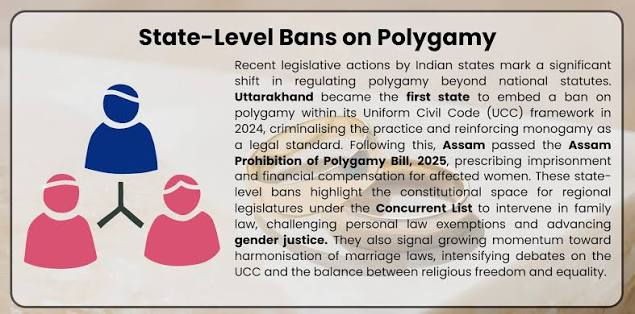
Polygamy in India: Law, Equality and the Debate over Personal Laws
Polygamy in India: Law, Equality and the Debate over Personal Laws
#RACEIAS #UPSC #CivilServices #IASPreparation #UPSCPreparation #CurrentAffairs
#RACEIAS #BestUPSCCoaching #BestUPPSCCoachin #RACEIASLucknow #RACEIASKanpur #CivilServicesExam
Introduction
Polygamy, or the practice of having more than one spouse at the same time, has long occupied a complex position in India’s legal and social landscape. Although monogamy is the general legal norm under several personal laws, Indian law has historically treated marriage differently across religious communities. This difference has increasingly become a subject of constitutional debate, particularly from the perspective of gender equality, dignity and the right to religious freedom. The Supreme Court’s notice to the Union Government in a Public Interest Litigation filed in Zakia Soman & Ors. v. Union of India has once again brought the issue into national focus. The petition seeks a declaration that polygamy among Muslims is unconstitutional and also calls for a uniform prohibition on bigamy and polygamy irrespective of religion. The controversy therefore extends beyond one community and raises a broader question: how should India balance personal-law autonomy with the constitutional promise of equality and individual dignity?
#UPSCNotes #GSPreparation #Prelims2027 #Mains2027 #BestIASCoaching
Legal Framework Governing Polygamy
The legal position on polygamy in India is shaped by a combination of statutory law, personal laws and judicial decisions. The Muslim Personal Law (Shariat) Application Act, 1937 directs that, in matters such as marriage and dissolution of marriage, Muslim personal law shall apply to Muslims. In practice, Muslim personal law has traditionally permitted a Muslim man to have more than one wife, subject to the principles governing such marriages. This position differs from the Hindu Marriage Act, 1955, which establishes monogamy as a legal requirement for Hindu marriages and makes a subsequent marriage during the lifetime of a spouse void, subject to the statutory conditions. Similar restrictions operate under other personal and secular marriage laws.
The Bharatiya Nyaya Sanhita, 2023, which replaced the Indian Penal Code, continues to criminalise marrying again during the lifetime of a husband or wife in circumstances covered by the law. Section 82 provides punishment that may extend to seven years in cases of legally punishable bigamy. However, the operation of this provision depends upon the applicable marriage law and the validity of the first and second marriages. The result is a legal framework in which the same conduct may attract different consequences depending upon the personal law governing the parties. This differential treatment forms the foundation of the present constitutional debate.
#RACEIAS #BestCivilServicesCoaching #BestIASCoachingLucknow
Constitutional Questions of Equality and Religious Freedom
The challenge to polygamy involves a difficult interaction between several fundamental rights. Petitioners opposing the practice argue that allowing polygamy under personal law creates unequal legal treatment and adversely affects women’s dignity and autonomy. Article 14 guarantees equality before law and equal protection of laws, while Article 15 prohibits discrimination on specified grounds, including religion and sex. Article 21 protects life and personal liberty and has, through judicial interpretation, acquired a broad meaning encompassing dignity, autonomy and various aspects of personal freedom.
At the same time, Article 25 guarantees freedom of conscience and the right to freely profess, practise and propagate religion, subject to public order, morality, health and other provisions of Part III of the Constitution. Articles 26 to 29 further protect aspects of religious and cultural autonomy. The central constitutional question is therefore whether a practice permitted under personal law can claim protection as part of religious freedom when it is alleged to conflict with equality and gender justice. The answer may depend upon whether the practice is considered an essential component of religion or merely a permissible social practice capable of regulation by the state.
#RACEIAS #BestCivilServicesCoachingLucknow #IASCoachingLucknow #UPSCCoachingLucknow
What Does the Data Say About Polygamy?
The debate over polygamy is often framed around particular religious communities, but demographic evidence presents a more nuanced picture. Data from the National Family Health Survey-5 for 2019–21 indicates that polygamous unions constitute a relatively small proportion of marriages in India and occur across different religious groups. The reported prevalence was approximately 2.1 per cent among Christians, 1.9 per cent among Muslims and 1.3 per cent among Hindus, against an overall national figure of around 1.4 per cent.
These figures are significant because they demonstrate that polygamy is not exclusively associated with one religious community. The practice has existed historically in different social and cultural settings, although its prevalence and legal treatment vary considerably. Consequently, the contemporary policy debate is not simply about prohibiting a religious practice; it is also about determining whether India should establish a common legal standard for marriage applicable to all citizens. At the same time, demographic prevalence alone cannot determine the constitutional validity of a practice. The constitutional inquiry must also consider individual rights, gender justice, religious freedom and the nature of state regulation.
#RACEIAS #LucknowIAS #KanpurIAS #KapoorthalaLucknow #IndiraNagarLucknow
Landmark Judicial Pronouncements
The Supreme Court has addressed different aspects of marriage, personal law and polygamy through several important judgments. In Sarla Mudgal v. Union of India (1995), the Court examined the practice of conversion to Islam by a Hindu husband seeking to contract another marriage without dissolving the first. It held that conversion did not automatically dissolve the existing Hindu marriage and that a second marriage contracted in such circumstances could attract the law relating to bigamy. The principle was subsequently reinforced in Lily Thomas v. Union of India (2000), strengthening the position that religious conversion cannot be used merely as a device to circumvent the legal obligations of an existing marriage.
In Javed v. State of Haryana (2003), the Supreme Court considered the relationship between polygamy and religious freedom. The Court observed that although Muslim personal law permits a Muslim man to have multiple wives, polygamy was not an essential religious practice protected absolutely under Article 25. The judgment therefore recognised the constitutional space available to the state to regulate the practice in appropriate circumstances.
Another major development came through Shayara Bano v. Union of India (2017), where a Constitution Bench invalidated the practice of instant triple talaq, known as talaq-e-biddat. The judgment represented a significant development in the relationship between personal law, gender justice and constitutional rights. However, the Court did not finally determine the constitutional validity of polygamy or nikah halala, leaving those questions open for future consideration. In Bhaurao Shankar Lokhande v. State of Maharashtra (1965), the Court also clarified that a prosecution for bigamy requires proof that the second marriage was validly solemnised according to the essential ceremonies applicable to that marriage. Thus, merely establishing a relationship between two individuals is not always sufficient to constitute the criminal offence of bigamy.
#RACEIAS #AlambaghLucknow #IASCoachingKanpur #UPSCCoachingKanpur #BestIASInstitute
Arguments for Universal Prohibition
Supporters of a complete prohibition on polygamy emphasise gender equality and individual dignity. They argue that a marital structure allowing one spouse to have multiple partners can create unequal power relations, particularly where women have limited economic independence. They contend that marriage should be based on equality, mutual commitment and equal legal status, and that the state should not preserve practices that may place one gender at a structural disadvantage.
Another argument is based on the constitutional doctrine that religious freedom does not provide unlimited immunity to every social practice associated with religion. If a practice is not essential to the religion and substantially affects fundamental rights, the legislature may have greater constitutional space to regulate it. Supporters also point to international examples where Muslim-majority countries have restricted or prohibited polygamy. Tunisia, for instance, has prohibited polygamous marriage, while countries such as Turkey have adopted a statutory monogamous marriage framework. These examples demonstrate that religious identity and legal prohibition of polygamy need not necessarily be considered incompatible.
#RACEIAS #BestUPSCCoaching #BestUPPSCCoachin #RACEIASLucknow #RACEIASKanpur #CivilServicesExam
Personal Law Autonomy and the Way Forward
Opponents of a judicially imposed prohibition caution against excessive state intervention in religious personal laws. They argue that Articles 25 and 29 recognise the importance of religious and cultural diversity in India and that reforms affecting personal laws should ideally emerge through democratic legislation and consultation with affected communities. From this perspective, the issue is not merely whether polygamy should be prohibited but also who should determine the boundaries of personal law: courts, legislatures or communities themselves.
A balanced approach should therefore combine constitutional principles with legislative clarity. Universal and compulsory registration of marriages can be strengthened to prevent fraudulent or concealed unions. Personal laws may be progressively codified to ensure greater transparency and gender equality. Economic protections for spouses and children should also be strengthened, particularly through effective maintenance, residence and inheritance safeguards. The legal system should ensure that women do not become economically vulnerable merely because of the marital structure recognised under a particular personal law.
#RACEIAS #GovernmentJobs #UPSCAspirants
Conclusion
The debate over polygamy represents a larger constitutional conversation about equality, religious freedom and the role of personal laws in a modern democratic society. The issue cannot be reduced to a conflict between religion and reform. It requires careful consideration of individual dignity, gender justice, cultural diversity and constitutional morality. The Supreme Court’s consideration of the challenge may provide an important opportunity to clarify the limits of personal-law autonomy and the extent to which fundamental rights can shape family law.
Ultimately, India’s objective should be to create a marriage-law framework in which every individual receives equal protection regardless of religious identity. Whether this is achieved through a Uniform Civil Code, reform and codification of personal laws, or a combination of legislative measures, the guiding principles should remain equality, dignity, autonomy and access to justice. A mature legal system must protect cultural diversity while ensuring that such diversity does not become a justification for denying basic constitutional rights. The future of the debate over polygamy will therefore be significant not only for marriage law but also for the evolving relationship between personal liberty, religious freedom and constitutional equality in India.