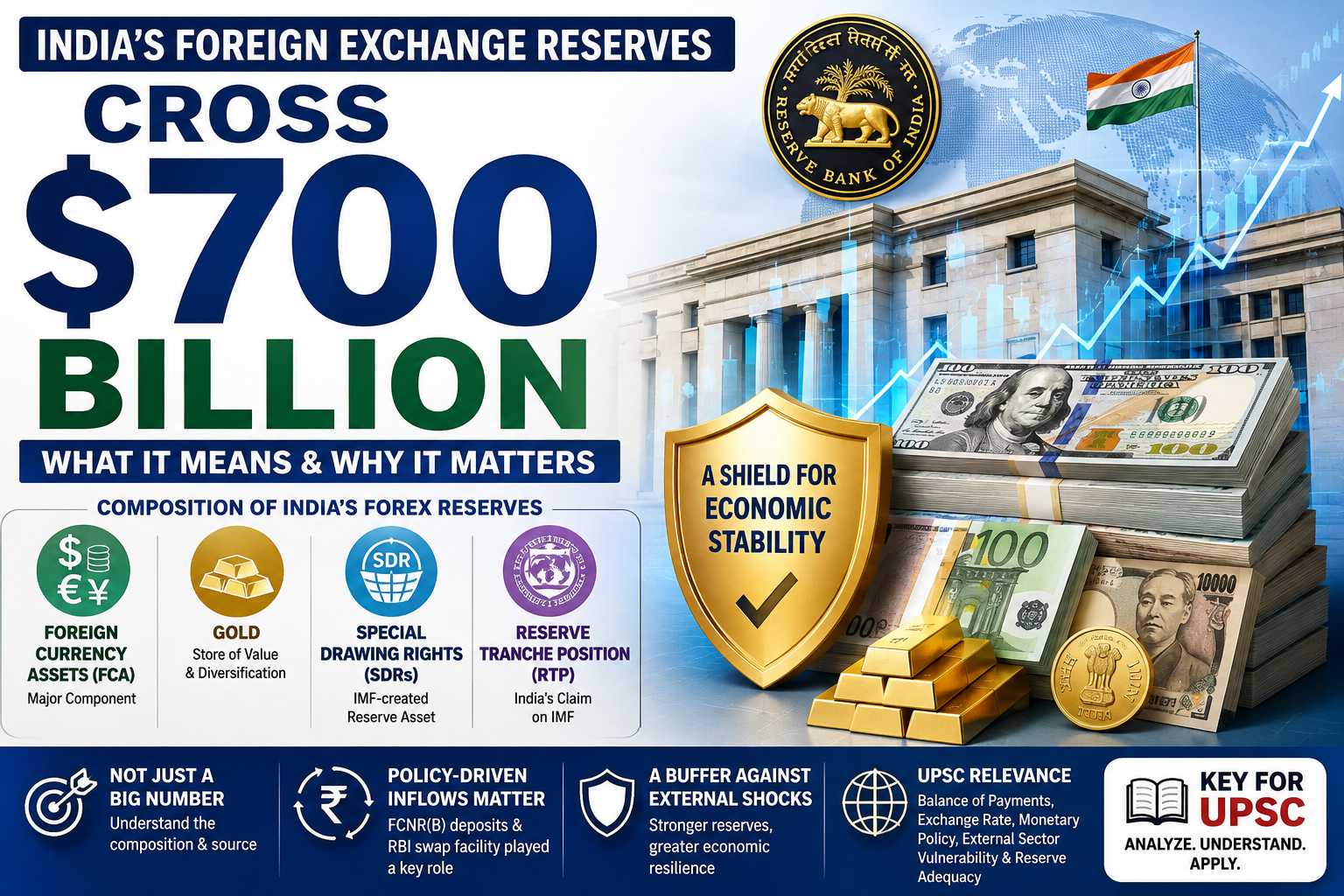
India’s $700-Billion Forex Reserves: What Do They Really Mean?
Core argument:
A large foreign-exchange reserve is a shield, not a scorecard.
The right question is not merely “How much does India have?” but “Why has India accumulated it, what liabilities stand behind it, how liquid is it, and how much external stress can it absorb?”
India’s foreign-exchange reserves crossed the $700-billion mark in August 2026, reaching about $707 billion as of August 7, after a weekly increase of $14.1 billion. The striking feature is not simply the size of the reserves but the composition and source of the recent accumulation. Policy-driven foreign-currency inflows—including the RBI's FCNR(B)-related swap facility—have played an unusually important role.
This makes the episode a particularly rich case study in Balance of Payments, exchange-rate management, monetary policy, external-sector vulnerability and reserve adequacy.
1. The headline number — $700 billion
The headline is impressive:
India's forex reserves > $700 billion
But a headline number can conceal several very different economic realities.
A rise in reserves can occur because of: strong merchandise exports; services exports; remittances; FDI; portfolio investment; external borrowing; NRI deposits; valuation gains on foreign assets; increase in gold prices; RBI purchases of foreign currency; special policy measures designed to attract foreign-currency funds.
Therefore:
Rise in reserves does not necessarily mean automatically rise in underlying economic strength
A country could accumulate reserves because its current account is strong.
Alternatively, it could accumulate reserves because it is borrowing or attracting foreign capital.
The implications are completely different.
2. What exactly are India's foreign-exchange reserves?
The RBI's framework identifies four components:
Foreign Currency Assets — FCA
Gold
Special Drawing Rights — SDRs
Reserve Tranche Position — RTP — with the IMF
Conceptual formula
Forex Reserves = FCA + Gold + SDRs + Reserve Tranche Position
3. Foreign Currency Assets — FCA
FCA is normally the largest component.
It represents foreign-currency-denominated assets held by the monetary authorities.
These can include:
deposits with foreign central banks;
deposits with foreign commercial banks;
balances with international institutions;
foreign government securities;
Treasury bills;
other high-quality foreign securities.
The RBI manages these assets according to principles involving: safety; liquidity; return; diversification.
The RBI specifically emphasises risks such as credit risk, market risk and liquidity risk in reserve management.
UPSC trap
FCA does NOT mean that RBI is literally holding $575 billion of currency notes.
A substantial part is invested in financial assets such as securities and deposits.
4. Gold reserves
Gold is another component of India's reserve assets.
Gold has a special character because it: does not carry conventional sovereign default risk; can act as a store of value; provides diversification; can strengthen confidence during periods of financial stress.
But gold's dollar value can fluctuate significantly because of changes in the international gold price.
Important analytical point
If gold prices rise sharply, India's reported forex reserves can increase even without a corresponding increase in foreign-currency inflows.
Therefore:
Change in reserve value is not necessarily equivalent change in Balance of Payments flows.
This is a classic valuation effect.
5. Special Drawing Rights — SDRs
SDR is an international reserve asset created by the IMF.
It is not a currency in the conventional sense.
Its value is based on a basket of major currencies.
India's SDR holdings form part of its official reserve assets.
Trap
SDR does not mean foreign currency deposit.
It is an IMF-created international reserve asset.
6. Reserve Tranche Position — RTP
India has a Reserve Tranche Position with the IMF, which represents a readily available claim arising from India's position with the IMF.
It forms part of India's official reserve assets even though it is not equivalent to dollars held in a bank account.
Prelims distinction
Component Basic idea
FCA Foreign-currency financial assets
Gold Monetary gold held as reserve asset
SDR IMF-created international reserve asset
RTP India's readily available claim on IMF
The RBI explicitly includes all four in India's foreign-exchange reserves.
7. Why have India’s Foreign Exchange reserves crossed $700 billion?
This is the real story.
Recent reserve accumulation has not been driven simply by a spectacular improvement in India's merchandise trade balance.
The major recent development has been policy-assisted foreign-currency mobilisation.
According to Reuters, India's reserves reached about $707 billion on August 7, 2026, with the $14.1-billion weekly rise driven predominantly by a $9.9-billion increase in FCA.
Reuters also reported that policy measures introduced from June generated more than $50 billion of FCNR(B) deposits, while other borrowing-related mechanisms added further inflows.
The RBI subsequently decided to close the discounted FX swap facility for FCNR(B)-related inflows earlier than initially planned.
8. FCNR(B): the important analytical link
FCNR(B) = Foreign Currency Non-Resident (Bank) deposits
These are deposits maintained by eligible non-residents in designated foreign currencies with Indian banks.
The important feature is:
The deposit is denominated in foreign currency.
Therefore, it can provide banks with foreign-currency resources.
The RBI's special swap mechanism made it more attractive for banks to mobilise such foreign-currency deposits.
According to Reuters, $52.3 billion had come through FCNR(B) deposits under the facility, with additional flows through other FX-raising mechanisms.
9. The deeper question: What kind of reserve accumulation is this?
This gives us an extremely useful analytical framework.
Route 1 — Current-account driven accumulation
Suppose:
Exports ↑ → foreign currency earnings ↑ →RBI purchases dollars → reserves ↑
This reflects stronger external earning capacity.
Route 2 — Capital-account driven accumulation
Suppose:
Foreign capital inflow ↑ → foreign currency supply ↑ → RBI intervention → reserves ↑
This may reflect investor confidence, interest-rate differentials or attractive financial opportunities.
Route 3 — Policy-induced capital mobilisation
Suppose:
RBI creates incentives → banks attract foreign-currency deposits → foreign currency enters India → reserves/liquidity position improves
This is different again.
Therefore:
Not every dollar added to reserves represents a dollar earned through exports.
This distinction should be central to the aspirants’ lerning.
10. A very important correction: Reserves are not the same as Balance of Payments strength
The Balance of Payments records transactions between residents and non-residents.
The reserve position is the stock of external assets held by monetary authorities.
Think of:
Flow
Current account + capital/financial account + errors & omissions → change in external reserves
But the observed change in reserves can also be influenced by: valuation changes; exchange-rate movements; gold-price movements; RBI intervention; changes in reserve asset composition.
Therefore, one should never infer the entire external-sector story merely by looking at the reserve number.
11. What can $700 billion actually do?
This is where reserves become economically meaningful.
A. Import protection
Reserves provide foreign exchange for critical imports.
For India, this is particularly important because of dependence on imported: crude oil; natural gas; electronics; machinery; critical minerals; defence equipment; industrial inputs.
A large reserve cushion reduces the probability that an external shock immediately creates an inability to finance imports.
B. Protection against sudden capital outflows
Imagine a global financial shock.
Foreign investors suddenly sell Indian: equities; bonds; other financial assets.
They want dollars.
Demand for dollars rises sharply.
The RBI can intervene by supplying foreign exchange.
Therefore:
Capital outflow → dollar demand ↑ → rupee pressure → RBI intervention → reserves ↓
This is one of the central functions of reserves.
12. Reserves as an insurance policy
A useful analogy for aspirants:
Forex reserves are like insurance.
You don't judge insurance by asking: “How much money can I spend from the insurance policy every day?”
You ask: “Will the policy cover me when a major shock occurs?”
Similarly, reserves are accumulated partly for a tail-risk event.
13. Oil shock: India's classic vulnerability
Consider a geopolitical crisis in West Asia.
Stage 1
Oil prices rise sharply.
Stage 2
India's import bill increases.
Stage 3
Demand for dollars rises.
Stage 4
Current account pressure increases.
Stage 5
Rupee comes under depreciation pressure.
Stage 6
RBI may intervene to reduce excessive volatility.
Stage 7
Reserves decline.
Therefore: Oil shock → current-account pressure → dollar demand → rupee pressure → possible RBI intervention → reserve depletion
A large reserve stock gives India time and policy space.
14. Reserves and the rupee: a common misconception
A common question is: If India has $700+ billion in reserves, why can't RBI simply prevent the rupee from depreciating?
It is because the RBI does not control the global demand and supply of dollars.
Suppose markets continuously demand dollars because of: high oil prices; capital outflows; stronger US interest rates; global risk aversion; import demand.
The RBI can sell dollars.
But every intervention reduces its reserve stock.
Therefore: Reserves can smooth volatility.
They cannot indefinitely defeat market fundamentals.
15. RBI's objective is not necessarily to defend a particular rupee level
India follows a market-determined exchange-rate system, while the RBI intervenes to manage excessive volatility and disorderly market conditions.
The distinction is crucial:
Exchange-rate targeting
“Rupee must remain at ₹X per dollar.” Versus Exchange-market intervention
“Rupee should not experience disorderly or destabilising movements.”
The second is much more consistent with India's framework.
The IMF has noted that India's FX interventions have been aimed at smoothing excessive volatility rather than maintaining an arbitrary fixed exchange rate.
16. The reserve intervention mechanism
Suppose the rupee is under excessive depreciation pressure.
RBI sells dollars
RBI foreign assets ↓ and receives Rupees from the market
Therefore: Dollar sale → rupee liquidity absorption
Conversely: RBI buys dollars RBI foreign assets ↑ and pays rupees into the banking system
Therefore: Dollar purchase → rupee liquidity injection
This creates an important connection between: Forex management ↔ monetary policy
17. The sterilisation problem
Suppose foreign capital enters India rapidly.
Banks receive foreign currency.
RBI purchases the foreign exchange.
The RBI pays rupees.
Therefore: Foreign inflow ↑ → RBI purchases dollars → domestic rupee liquidity ↑
If this liquidity becomes excessive, it may complicate monetary management.
The RBI can therefore undertake sterilisation.
Broadly: Sterilisation means offsetting the monetary impact of foreign-exchange intervention.
This is one of the most important concepts linking external-sector management with monetary policy.
18. Why the recent inflows create a policy dilemma
The recent policy-driven inflows are useful because they: strengthen the external position; increase reserve buffers; improve Balance of Payments comfort; provide support against external shocks; reduce immediate pressure on the rupee.
But they also create potential costs.
Reuters reported concerns around: domestic liquidity; inflation management; external liabilities; maturity risks; forward-premium costs.
These considerations were among the factors behind the RBI's decision to close the FCNR(B)-related swap window earlier than originally planned.
19. The hidden issue: reserves have a liability counterpart
This is perhaps the most sophisticated point in the entire story.
Imagine India attracts $50 billion through foreign-currency deposits.
The reserve position may increase.
But:
India has not necessarily “earned” $50 billion.
It has obtained foreign currency against an obligation.
There is a corresponding liability somewhere in the financial system.
Therefore:
A reserve increase financed through borrowing is economically different from a reserve increase generated by export earnings.
This is why:
Gross reserves should not be viewed in isolation from external liabilities.
20. Gross reserves versus net external position
Suppose: Reserves = $700 billion
But suppose external liabilities are also very large.
Then the country's overall external balance sheet must be examined.
Relevant questions include:
How much external debt exists?
How much is short-term?
How much foreign portfolio investment can exit quickly?
What is the maturity profile?
How large are banking-sector foreign-currency liabilities?
How large is the current-account deficit?
How dependent is the country on imported energy?
Hence: Reserve adequacy is a balance-sheet question, not a headline-number question.
21. The $700-billion reserve stock should therefore be read through five lenses
Lens 1 — Size
How large are reserves?
Lens 2 — Composition
What are reserves made of?
FCA, gold, SDRs and RTP.
Lens 3 — Source
Why did reserves rise?
Exports?
Services?
Remittances?
FDI?
FPI?
Borrowing?
NRI deposits?
RBI intervention?
Valuation gains?
Lens 4 — Adequacy
Are reserves sufficient relative to vulnerabilities?
Lens 5 — Cost
What liabilities and macroeconomic costs accompany reserve accumulation?
This five-lens framework can become the signature analytical framework of the aspirants
22. Reserve adequacy: the real measure of strength
The crucial question is not: “Does India have $700 billion?”
It is: “Is $700 billion adequate relative to India's external risks?”
This is the correct macroeconomic question.
23. Import cover
The traditional measure is: Import Cover = Forex Reserves / Average Monthly Imports
It tells us approximately how long a country can finance imports using its reserves, assuming no additional foreign-exchange earnings.
The traditional benchmark often discussed is around three months of imports, although modern reserve adequacy assessment is much more sophisticated.
The IMF's recent assessment found India's reserves to be above eight months of import coverage at end-FY2024/25.
Trap
Import cover is useful but not sufficient.
A country with a highly open capital account may face a capital-flow shock much larger than its normal import requirement.
24. Short-term external debt
Another critical indicator: Reserves / Short-term external debt
Why?
It is because short-term external debt must be rolled over or repaid relatively quickly.
If foreign lenders suddenly refuse to roll over financing, foreign-exchange demand can rise sharply.
The classic Greenspan-Guidotti principle emphasises the ability to cover short-term external debt.
(Greenspan-Guidotti principle says, a country should hold foreign exchange reserves equal to or greater than its total short-term external debt maturing within one year. This guideline ensures a nation can service its immediate foreign obligations for one year without relying on new capital inflows).
The IMF notes that traditional reserve metrics include import coverage and reserve-to-short-term-debt ratios, while modern metrics incorporate several sources of external vulnerability.
25. India's reserve position relative to short-term debt
The IMF's 2025 Article IV assessment found India's reserves at end-FY2024/25 equivalent to roughly 209% of short-term debt on a residual-maturity basis, alongside more than eight months of import coverage.
This is an important point: India does not merely have a large absolute reserve stock.
It also has a substantial reserve buffer relative to important external vulnerabilities.
26. Current Account Deficit — CAD
Another important variable is: Current Account Deficit
If: Imports + income payments + other current outflows > exports + current receipts, then the country has a current-account deficit.
A CAD is not automatically bad.
It can be sustainable if financed by stable capital inflows such as:
FDI; long-term capital; productive investment.
The problem arises when a persistent CAD is financed disproportionately through: volatile portfolio flows; short-term debt; speculative capital.
Therefore: The quality of financing matters as much as the size of the deficit.
27. FDI versus portfolio flows
FDI
Generally: longer-term; linked to productive assets; relatively less reversible.
Portfolio flows
Generally: more liquid; more sensitive to global interest rates; more sensitive to risk sentiment; capable of reversing rapidly.
Hence:
$1 billion of FDI inflow is not $1 billion of portfolio inflow from the perspective of external vulnerability.
28. The “sudden stop” problem
A sudden stop occurs when external financing that a country had been receiving abruptly dries up or reverses.
For India, potential sources of external pressure include:
FPI outflows; external debt rollover problems; higher oil prices; global dollar appreciation; geopolitical shocks; resident capital flight; deterioration in investor confidence.
This is precisely why reserve adequacy has to be assessed against multiple potential drains.
29. IMF's broader reserve adequacy framework
The IMF's reserve adequacy framework goes beyond simply asking how many months of imports can be financed.
Its emerging-market approach considers potential pressures from: Export income shock, Broad-money-related capital flight, Short-term debt,Other portfolio liabilities
The IMF's ARA framework uses risk-weighted measures rather than relying on a single rule of thumb.
UPSC takeaway
Modern reserve adequacy = vulnerability-adjusted assessment.
Not merely: Reserves ÷ Imports
30. Why absolute reserve size can be misleading
Imagine two countries:
Country A
Reserves = $500 billion
External debt = $300 billion
Short-term debt = $50 billion
Current-account position = strong
Country B
Reserves = $700 billion
External debt = $1 trillion
Large CAD
Large volatile portfolio liabilities
Which is more externally resilient?
Not necessarily Country B.
Therefore:
Reserve adequacy is relative, not absolute.
31. Reserves are not national wealth
This deserves a separate box in the column.
Forex reserves are not a component used to calculate GDP
GDP measures economic production over a period.
Forex reserves are a stock of external financial assets.
Foreign currency held by a country's central bank is not income that the government can spend on its budget, public services, or infrastructure.
Government revenue is a fiscal flow.
Reserves are monetary-authority external assets.
Forex reserves is not fiscal surplus this means that a country's stockpile of foreign currencies held by its central bank is entirely different from the government running a budget surplus where tax revenues exceed public spending.
A government can run a fiscal deficit while the country accumulates reserves.
Forex reserves do not reflect household wealth, household wealth means that a country's national foreign currency savings do not belong to its citizens and cannot be used to pay off personal debts or increase household spending.
Reserves belong to the monetary authorities and are managed for external-sector and monetary purposes.
32. Can the government spend the $700 billion?
This is a dangerous simplification.
The government cannot simply say: “We have $700 billion, so let's spend $100 billion on infrastructure.”
Why?
It is because reserves exist primarily as external reserve assets, managed for: external payments; exchange-market intervention; confidence; liquidity; external shock absorption.
Converting reserves into domestic government spending would fundamentally alter the monetary and external position.
33. Reserve accumulation has an opportunity cost
Holding reserves is not free. The RBI invests reserve assets predominantly in safe and liquid instruments.
The return on these assets may be lower than the potential return from alternative domestic investment.
Therefore: Reserve accumulation has an opportunity cost.
But the benefit is: Insurance against a costly external crisis.
This creates a classic policy trade-off:
Return on alternative assets vs insurance value of reserves
34. Another cost: sterilisation
When RBI buys foreign exchange:
Foreign assets ↑ Rupee liquidity ↑
If the RBI sterilises that liquidity, it may incur a fiscal/quasi-fiscal or balance-sheet cost depending on the instruments and market conditions.
Therefore:
Reserve accumulation can have monetary consequences.
35. Another cost: borrowing-funded reserves
If reserves rise because of foreign borrowing or foreign-currency deposits, the country may simultaneously acquire: Foreign asset and Foreign liability.
Hence, reserve accumulation through debt can improve liquidity without proportionately improving the net international investment position.
This distinction is extremely important.
36. Gross reserves versus Net International Investment Position
Gross reserves
What external reserve assets does the monetary authority possess?
Net International Investment Position — NIIP
Broadly: External assets − External liabilities
Therefore, a country can have: high reserves; but also, high external liabilities.
So: High reserves do not automatically imply a positive net international investment position.
37. Why the RBI may want reserves even when they are already “adequate”
There is an apparent contradiction.
If reserves are already adequate, why accumulate more?
This is because reserve adequacy is not static.
External risks change.
For example: oil prices may rise; global interest rates may change; geopolitical tensions may intensify; capital flows may reverse; imports may increase; external debt may grow.
Therefore, an adequate reserve level today may become less comfortable tomorrow.
38. But “more is always better” is also wrong
There is a point beyond which additional reserves may provide diminishing marginal benefit.
The IMF has repeatedly emphasised that when reserves are already adequate, further accumulation may be less warranted and intervention should focus on disorderly market conditions.
This gives us a sophisticated policy principle: Optimal reserves, not maximum reserves.
39. The recent $700-billion episode: a nuanced interpretation
The latest episode can be interpreted at three levels.
Positive interpretation
India has: a substantial external buffer; greater ability to manage external shocks; stronger capacity to smooth rupee volatility; greater confidence among international investors; improved Balance of Payments comfort.
Cautionary interpretation
Part of the recent rise is associated with policy-induced foreign-currency mobilisation, rather than simply stronger exports or a structurally transformed current account.
Reuters reported that nearly $57 billion was drawn through the relevant FX-swap measures, contributing significantly to the reserve build-up.
Deeper interpretation
The central question becomes: How durable are these inflows, and what liabilities accompany them?
That is much more important than celebrating the $700-billion number.
40. The RBI's early closure of the FCNR(B) swap window
This development itself is analytically significant.
The facility was initially intended to remain open longer.
But after attracting more than $50 billion, the RBI chose to close the relevant window earlier than planned.
Why?
Possible policy considerations include: diminishing marginal benefit of additional inflows; liquidity-management concerns; forward-premium costs; external liability accumulation; maturity considerations; reduced need for further reserve mobilisation.
Reuters reported that the RBI expected total inflows through subsidised swap windows to be around $80 billion, illustrating how large the response to the policy measures had become.
41. A fascinating policy paradox
The RBI wants foreign currency because: More dollars → stronger external buffer
But too much foreign-currency inflow can create: More rupee liquidity → monetary-management problem
And if the inflows are debt-creating: More reserves → more external liabilities
Therefore:
The same policy can produce both a benefit and a vulnerability.
This is an excellent example of second-order effects in economic policy.
42. Forex reserves and monetary policy: the impossible trinity connection
India's experience also connects with the Impossible Trinity / Trilemma.
A country cannot simultaneously maintain: a completely fixed exchange rate;
completely free capital mobility; an independent monetary policy.
India has: substantial capital mobility; monetary-policy independence;a flexible/market-determined exchange rate with intervention.
Therefore, the RBI has to balance: Capital flows ↔ exchange rate ↔ domestic liquidity/interest rates
Forex intervention gives the RBI some room, but not unlimited freedom.
43. Why reserves cannot permanently defend the rupee
Suppose RBI decides: “₹95 per dollar is unacceptable; we will defend ₹95 indefinitely.”
If market forces continuously push the rupee toward ₹100: RBI sells dollars.
Reserves: $700 bn → $650 bn → $600 bn → $500 bn...
At some point markets may recognise that the defence is unsustainable.
The pressure can then intensify.
This is why:
A reserve stock creates intervention capacity, not unlimited intervention power.
44. Reserve depletion is not automatically bad
This is another important nuance.
Suppose reserves decline from: $700 billion → $650 billion
That does not automatically mean the economy has weakened.
If the decline occurs because RBI sells dollars during a temporary external shock, reserves are performing their intended function.
Reserves are like a shock absorber.
A shock absorber is expected to compress when the vehicle hits a bump.
Similarly:
A temporary reserve decline during an external shock may demonstrate the usefulness of reserves rather than their weakness.
45. Conversely, reserve accumulation is not automatically good
Suppose reserves rise by $50 billion because of: short-term foreign borrowing;
volatile portfolio flows; temporary policy incentives.
That does not necessarily represent a structural improvement in external competitiveness.
Hence:
The direction of reserves is less important than the mechanism behind the movement.
46. The Balance of Payments identity
For UPSC purposes, keep the basic conceptual structure clear: Current Account + Capital/Financial Account + Errors & Omissions = Change in Reserve Assets
In simplified form: BoP surplus → reserves tend to rise
BoP deficit → reserves tend to fall
But in the real world, valuation changes and reserve-management operations complicate the simple interpretation.
47. What determines India's external resilience?
A sophisticated assessment should combine: External earnings, merchandise exports; services exports; remittances, External financing, FDI; portfolio flows; external commercial borrowing; NRI deposits.
External obligations external debt; short-term debt; portfolio liabilities; banking-sector foreign liabilities.
Shock exposure
oil imports; geopolitical risk; global interest rates; dollar strength; global risk appetite.
Reserve buffer
FCA; gold; SDR; RTP.
48. A useful “Reserve Resilience Equation”
For academic purposes: Reserve Resilience = Reserve Stock ÷ External Vulnerability
External vulnerability includes: Short-term debt + volatile capital flows + import requirements + CAD + potential capital flight + commodity-price shocks
It is not a formal accounting equation, but it is an excellent conceptual framework.
49. Five questions to ask whenever reserves rise
Question 1
How much did reserves rise?
Question 2
Which component rose?
FCA? Gold? SDR? RTP?
Question 3
Why did they rise?
Exports? FDI? FPI? Borrowing? NRI deposits? RBI intervention? Valuation?
Question 4
What liabilities accompanied the inflow?
Question 5
Are reserves adequate against India's external vulnerabilities?
This five-question framework can be used for every future forex-reserve news item.
50. Prelims Precision Box
Foreign Exchange Reserves
Component What it represents
Foreign Currency Assets Foreign-currency financial assets held by monetary authorities
Gold Monetary gold held as a reserve asset
SDRs IMF-created international reserve asset
Reserve Tranche Position India's readily available claim on the IMF
Remember
Forex reserves are reserve assets—not the same as national wealth.
The RBI manages the country's reserves, while SDRs and the IMF reserve position are reflected in the Government of India's books but are included in official reserve figures because they are readily available to the monetary authority.
51. Prelims Traps
Statement 1
All forex reserves are held in the form of foreign currency notes. - False.
Statement 2
Gold forms part of India's foreign-exchange reserves.- Correct.
Statement 3
SDRs are created by the RBI.- False. (They are created by the IMF).
Statement 4
Reserve Tranche Position with the IMF forms part of India's official reserve assets.- Correct.
Statement 5
An increase in forex reserves necessarily implies a current-account surplus.- False.
(Capital/financial inflows, valuation changes and RBI intervention can also affect reserves).
Statement 6
A fall in reserves always indicates deterioration in the external sector.- False.
(Reserves can deliberately fall when the RBI uses them to manage excessive exchange-rate volatility).
52. Mains Analytical Framework
For a 15-marker, structure the answer as:
Introduction
Mention India's crossing of the $700-billion threshold and immediately challenge the simplistic interpretation.
The significance of India's record reserves lies less in their absolute size than in the external risks they can insure against and the nature of the flows that generated them.
Body I — Why reserves matter
import financing;
external shock absorption;
protection against sudden stops;
exchange-rate intervention;
investor confidence.
Body II — Why the number alone is insufficient
source of accumulation;
capital versus current-account flows;
valuation effects;
external liabilities;
maturity profile;
volatility of financing.
Body III — Recent FCNR(B) episode
policy-driven foreign-currency mobilisation;
reserve accumulation;
support to BoP;
liquidity implications;
external liability implications;
early closure of the facility.
Body IV — Adequacy
Assess against:
import cover; short-term external debt; CAD; external debt; portfolio liabilities;
oil dependence; capital-flight risk.
Conclusion
India's $700-billion reserve stock should therefore be viewed as a formidable external insurance buffer rather than as a simple measure of national economic strength. The quality, durability and financing of reserve accumulation—and its adequacy relative to external vulnerabilities—matter more than the headline number itself.
53. Mains Question
“India's foreign-exchange reserves crossing the $700-billion mark reflects considerable external-sector resilience, but the size of reserves alone cannot be regarded as a measure of economic strength.” Discuss.
Suggested dimensions
External resilience → Reserve adequacy → Source of inflows → External liabilities → RBI intervention → Monetary consequences → Long-term sustainability
54. Interview Question
If India has more than $700 billion in forex reserves, why can't the RBI simply use these reserves to permanently prevent depreciation of the rupee?
Model answer
Since, India's exchange rate is market determined and the RBI's intervention is primarily intended to contain excessive volatility rather than defend an arbitrary exchange-rate level. Persistent depreciation pressure reflects underlying demand and supply conditions for foreign exchange—such as oil imports, capital outflows and global dollar strength.
The RBI can sell dollars to moderate volatility, but every sale reduces its reserve stock. Attempting to permanently defend an unsustainable exchange rate can therefore exhaust reserves and create expectations of further depreciation.
Moreover, excessive intervention has monetary and financial consequences.
Thus: Reserves provide the capacity to smooth adjustment; they do not eliminate the underlying economic forces driving the exchange rate.
55. The Big Conceptual Distinction
Reserve Accumulation vs Economic Strength
Reserve accumulation Economic strength
Stock of external reserve assets Capacity to produce income and wealth
Can rise through capital inflows Depends on productivity and competitiveness
Can rise through borrowing Requires sustainable income generation
Can rise through valuation gains Depends on real economic fundamentals
Can reflect RBI intervention Depends on underlying external balance
Provides insurance Provides earning capacity
Therefore: Reserves are a buffer against weakness; they are not proof that weakness does not exist.
56. The Analytical Chain
These whole notes can be reduced to one powerful chain:
$700 billion reserves
↓
What constitutes them?
FCA + Gold + SDR + RTP
↓
Why did they rise?
Foreign inflows + policy measures + RBI intervention + valuation
↓
Are these flows sustainable?
Depends on source and liabilities
↓
What do reserves protect against?
Capital outflows + oil shocks + external financing stress
↓
Can RBI use them indefinitely?
No — finite stock
↓
Does reserve accumulation have costs?
Liquidity + sterilisation + opportunity cost + external liabilities
↓
So, what matters?
Reserve adequacy relative to external vulnerability
That is the core intellectual journey of the notes.
57. The One-Line Takeaway for Aspirants
“Do not ask whether India has enough reserves; ask whether its reserves are adequate, liquid, sustainably accumulated and sufficient against the liabilities and shocks it faces.”
58. Final Takeaway
The $700-billion milestone is undoubtedly significant. But the more interesting story lies beneath it.
India has built one of the world's largest external buffers, giving the RBI substantial capacity to respond to external shocks. Yet the composition and financing of the recent increase matter enormously. The 2026 FCNR(B)-linked inflows demonstrate that reserves can be augmented deliberately through policy intervention; such inflows strengthen immediate external liquidity but may also create liquidity-management challenges and corresponding external obligations.
The correct analytical conclusion is therefore neither: “$700 billion means India's economy is extraordinarily strong.” nor: “Policy-induced inflows make the reserves meaningless.”
The correct conclusion is more nuanced:
India's $700-billion reserves represent a formidable insurance buffer. But the true measure of external strength lies in the relationship between reserves, the nature of the inflows that created them, external liabilities, current-account vulnerability, capital-flow volatility and the economy's capacity to generate foreign exchange sustainably.
That is the distinction between reading a number and understanding an economy.
Current-affairs update: As of August 20, 2026, the most recent reported milestone is about $707 billion as of August 7; the RBI has also indicated that inflows through subsidised swap windows could total around $80 billion, while the FCNR(B)-related facility was brought to an early close after inflows exceeded $50 billion