India's R&D Ecosystem: Private Sector Surpasses Government in GERD (R&D Statistics 2025-26)
India's R&D Ecosystem: Private Sector Surpasses Government in GERD (R&D Statistics 2025-26)
Why in News?
The Department of Science and Technology (DST) released the Research & Development Statistics 2025-26, showing that India's Gross Expenditure on Research and Development (GERD) reached ₹2.45 lakh crore (0.84% of GDP) during 2023-24.
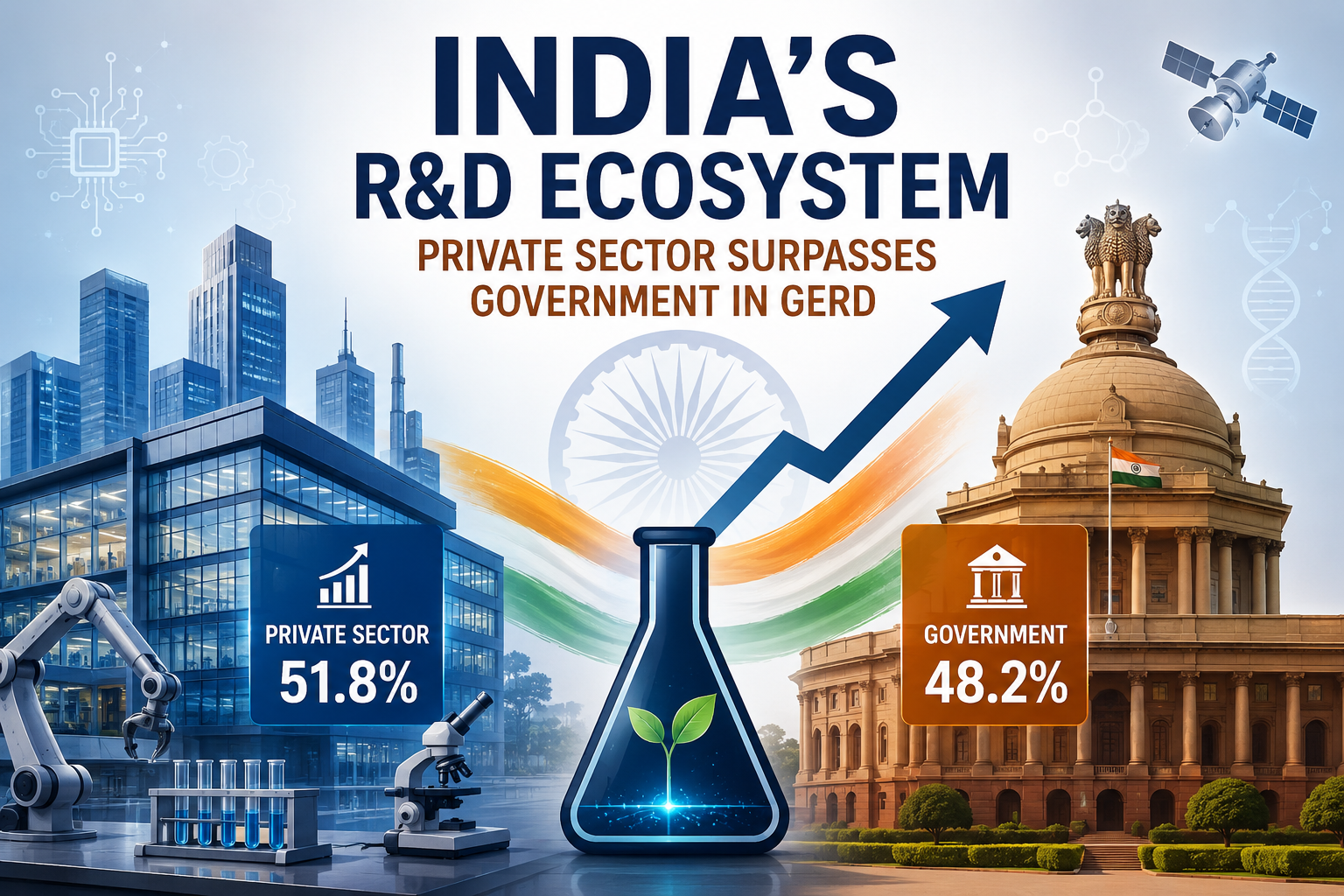
For the first time, private sector investment (51.8%) exceeded government investment (48.2%) in national R&D expenditure.
Key Data
|
Indicator |
2023-24 |
|
GERD |
₹2,44,767.81 crore |
|
GERD as % of GDP |
0.84% |
|
Private Sector Share |
51.8% |
|
Government Share |
48.2% |
|
Central Government |
₹85,711.50 crore |
|
Higher Education |
₹30,908.53 crore |
|
State Governments |
₹9,796.10 crore |
What is GERD?
Gross Expenditure on Research and Development (GERD) refers to
Total expenditure incurred by all resident institutions—including government, private industry, higher education institutions and non-profit organizations—on research and experimental development carried out within the country during a given year.
GERD is internationally recognised by the OECD Frascati Manual as the standard indicator for measuring national R&D intensity.
Components of India's R&D Ecosystem
Government
- DST
- DBT
- DRDO
- ISRO
- ICMR
- CSIR
- ICAR
- DAE
Focus:
- Basic science
- Strategic research
- Defence
- Space
- Agriculture
- Health
Higher Education
Includes
- IITs
- IISc
- Central Universities
- State Universities
- Research Institutes
Focus:
- Basic research
- Human capital
- Publications
- Innovation
Private Sector
Major contributors include
- Pharma
- Biotechnology
- IT
- Semiconductors
- Automotive
- Electronics
- AI
- Green Energy
- Telecom
Focus:
- Commercialisation
- Patents
- Product innovation
- Industrial R&D
Why is this Development Significant?
1. Structural Shift
Earlier
Government → dominant investor
Now
Industry → largest investor
This reflects
Transition from state-driven innovation towards a market-led innovation ecosystem.
2. Indicates Maturing Innovation Economy
Businesses invest only when they expect
- technological competitiveness
- export gains
- productivity improvements
- intellectual property generation
Hence,
Higher private R&D generally indicates
- technological confidence
- industrial sophistication
- innovation capacity
3. Better Industry-Academia Linkages
Private investment can improve
- applied research
- commercialization
- startup ecosystem
- technology transfer
4. Boosts Atmanirbhar Bharat
Domestic R&D helps
- reduce technology imports
- improve strategic autonomy
- develop indigenous technologies
5. Supports Viksit Bharat 2047
Innovation-driven growth
instead of
resource-driven growth
Government Initiatives
Research Development and Innovation (RDI) Fund
₹1 lakh crore
Objective
- encourage private R&D
- support deep-tech
- finance high-risk innovation
- promote commercialization
ANRF
Anusandhan National Research Foundation
Central allocation
₹14,000 crore
Objectives
- university research
- industry collaboration
- multidisciplinary science
- innovation ecosystem
Other Relevant Initiatives (Add These)
National Quantum Mission
Focus
- quantum computing
- communication
- sensing
- materials
IndiaAI Mission
Supports
- AI infrastructure
- GPUs
- startups
- research ecosystem
National Supercomputing Mission
Supports
- HPC
- scientific computing
- AI research
Biotechnology Research Innovation Council (BRIC)
Strengthens
- biotech research
- translational science
- public health innovation
PM Research Fellowship (PMRF)
Promotes
- doctoral research
- high-quality scientific manpower
Startup India
Supports commercialization of innovation.
Atal Innovation Mission
Creates innovation ecosystem through
- Atal Tinkering Labs
- Incubation Centres
Production Linked Incentive (PLI)
Indirectly promotes industrial R&D by encouraging domestic manufacturing in sectors such as electronics, pharmaceuticals and semiconductors.
Global Comparison
|
Country |
GERD (% GDP) |
|
Israel |
~6% |
|
South Korea |
~5% |
|
United States |
~3.5% |
|
Japan |
~3.3% |
|
Germany |
~3.1% |
|
China |
~2.6% |
|
OECD Average |
~2.7% |
|
India |
0.84% |
Inference
India's absolute expenditure is rising, but R&D intensity remains well below major innovation-driven economies.
Why India's R&D Intensity Remains Low
Limited Private Investment Until Recently
Historically,
Government financed most R&D.
Weak University Research
Many universities remain
- teaching-oriented
- underfunded
- publication-driven rather than innovation-driven
Industry-Academia Disconnect
Research often remains
laboratory-based
without commercialization.
Low Patent Culture
Compared to advanced economies
India files fewer high-value patents.
Limited Venture Capital for Deep Tech
Most investments still favour
- fintech
- e-commerce
instead of
- semiconductors
- materials science
- advanced manufacturing
Regulatory Delays
Long approval timelines
discourage innovation.
Brain Drain
Many top researchers move abroad.
Opportunities Created
- AI
- Robotics
- Space Economy
- Quantum Technologies
- Semiconductor Manufacturing
- Green Hydrogen
- Biotechnology
- Defence Manufacturing
- Climate Technologies
- Advanced Materials
Challenges Ahead
Even though private spending has crossed 50%, certain concerns remain.
Concentration Risk
Most spending comes from
few large companies.
MSME Participation
Still limited.
Regional Imbalance
Research clusters remain concentrated in
- Bengaluru
- Hyderabad
- Pune
- NCR
- Chennai
Basic Science
Private firms usually invest in
applied research,
while
basic science continues to depend upon government funding.
Public Universities
Need sustained support despite increasing private investment.
Economic Significance
Higher R&D leads to
- productivity growth
- higher exports
- better manufacturing competitiveness
- import substitution
- high-quality employment
- higher Total Factor Productivity (TFP)
- movement up the global value chain
Linkages with Other Government Programmes
- Make in India
- Startup India
- Digital India
- National Education Policy (NEP) 2020
- Semiconductor Mission
- National Green Hydrogen Mission
- National Quantum Mission
- BioE3 Policy
- IndiaAI Mission
- Viksit Bharat 2047
Constitutional & Policy Linkages
- Article 51A(h): Develop scientific temper, humanism and the spirit of inquiry and reform.
- Directive Principles (Article 38): Promote welfare through scientific and economic advancement.
- National Education Policy 2020: Emphasizes research universities and multidisciplinary innovation.
- Science, Technology and Innovation Policy (STIP): Although the updated STIP is yet to be formally adopted, it seeks to increase GERD, strengthen open science and foster industry–academia collaboration.
Possible UPSC Prelims Areas
- GERD
- Difference between GERD and GDP
- ANRF
- RDI Fund
- OECD Frascati Manual
- National Quantum Mission
- PM Research Fellowship
- Atal Innovation Mission
- BioE3 Policy
- India AI Mission
UPSC Mains Relevance
GS Paper III
Science & Technology
- Role of R&D in innovation
- Industry-academia collaboration
- Deep-tech ecosystem
- Indigenous technology development
Economy
- Innovation-led growth
- Productivity
- Manufacturing competitiveness
- Export diversification
Governance
- Public funding versus private funding
- Research institutions
- Centre–State coordination
Possible Mains Questions
1. Private sector investment has emerged as the principal driver of India's research ecosystem. Examine the opportunities and challenges associated with this transition. (15 Marks)
2. Research and Development is increasingly becoming the foundation of economic competitiveness in the 21st century. Discuss India's progress and the reforms required to build an innovation-driven economy. (15 Marks)
3. Discuss the role of industry–academia collaboration in achieving the objectives of Viksit Bharat 2047.
Interview Relevance
The board may move beyond the statistics to assess your analytical ability. Be prepared to discuss:
- Why advanced economies spend a much larger share of GDP on R&D than developing countries.
- Whether private-sector dominance in R&D could lead to underinvestment in basic science and how governments should respond.
- The distinction between research, innovation, invention, and commercialisation.
- Whether India should prioritise increasing GERD as a percentage of GDP or improving the efficiency and outcomes of existing expenditure.
- The role of universities in fostering innovation and entrepreneurship under NEP 2020.
- How R&D can contribute to strategic autonomy in sectors such as semiconductors, defence, biotechnology, AI and clean energy.
- Measures to improve industry–academia collaboration and encourage MSMEs to undertake research.
One-Line Takeaway
India's R&D ecosystem is entering a new phase where private enterprise has become the principal investor, signalling a shift towards an innovation-led growth model. The next challenge is to raise R&D intensity, strengthen basic research, broaden participation beyond large firms, and translate research investments into globally competitive technologies, patents, and productivity gains.