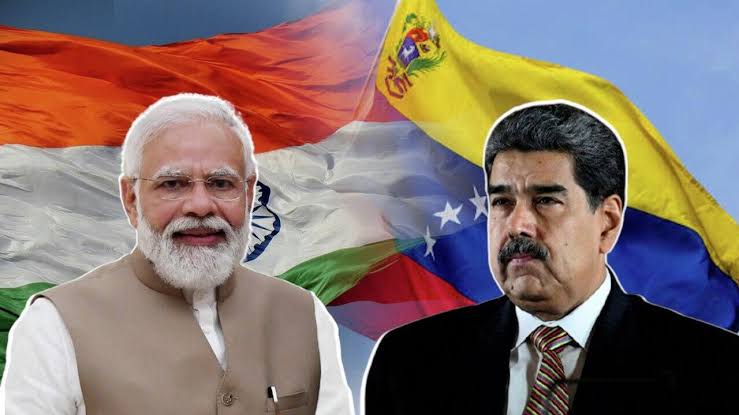
The Evolution of South-South Pragmatism: India-Venezuela Bilateral Relations
The Evolution of South-South Pragmatism: India-Venezuela Bilateral Relations
Introduction: A New Chapter in Trans-oceanic Diplomacy
The shifting dynamics of global geopolitics have forced emerging economies to continuously re-evaluate their resource dependencies and foreign alliances. Within this context, the relationship between India and Venezuela stands out as an interesting study of South-South cooperation. Originally built on shared anti-colonial histories and non-aligned principles, this trans-oceanic partnership has rapidly transformed into an economic arrangement based on structural necessity. The foundational ties between New Delhi and Caracas are no longer merely diplomatic formalities; they are now driven by India’s massive energy demands and Venezuela’s need for reliable economic outlets. As both nations navigate a world increasingly defined by geopolitical volatility, their bilateral relationship has taken on a renewed significance, bridging the geographical distance between South Asia and South America.
Contextualizing the 2026 Diplomatic Realignment
The contemporary trajectory of India-Venezuela relations was highlighted by a significant five-day official visit to India by Venezuela’s Acting President, Delcy Rodríguez. This visit marked the first high-level, formal diplomatic engagement between the two countries following a period of complex political shifts and leadership transitions within Caracas. The timing of this diplomatic mission is highly notable, occurring at a moment when traditional global energy markets face severe strain. The discussions between Indian leadership and the Venezuelan delegation focused heavily on securing long-term economic commitments rather than superficial political agreements. Specifically, the talks prioritized increasing India’s operational footprint within Venezuela’s expansive hydrocarbon reserves while concurrently designing frameworks to diversify bilateral trade into secondary sectors such as industrial mining, pharmaceuticals, and agricultural technologies.
Macroeconomic Dynamics and the Industrial Synergies
The economic exchange between India and Venezuela is characterized by a unique structural asymmetry that highlights the core strengths of both economies. During the 2025-26 fiscal year, cumulative bilateral trade between the two nations reached an estimated $678.94 million. While this total is notable, the balance of trade remains heavily tilted in Venezuela’s favor, a direct consequence of India's large-scale imports of high-value energy resources. The composition of this trade reveals a deep, mutual structural fit. India’s export basket to Venezuela is dominated by consumer-ready pharmaceuticals, active pharmaceutical ingredients (APIs), chemical compounds, and specialized biological products. In contrast, the inbound cargo to India consists almost exclusively of crude petroleum, mineral fuels, and recycled scrap metals. This exchange pattern illustrates how India acts as a manufacturing and technology provider, while Venezuela functions as a major supplier of raw industrial inputs.
The Micro-Mechanics of Oil Diplomacy and Refining Infrastructure
At the absolute center of this bilateral equation is a remarkable technological alignment involving India’s advanced downstream refining infrastructure. Venezuela possesses the largest proven oil reserves on the planet, estimated at roughly 303 billion barrels—a volume that constitutes between 17% and 20% of the entire global total. However, Venezuelan crude is heavily characteristic; it is classified as ultra-heavy and sour, meaning it has high viscosity and high sulfur content, making it difficult for standard refineries to process.
This is where India’s industrial capabilities become vital. Massive Indian processing facilities, most notably Reliance Industries’ Jamnagar refinery complex, are custom-designed and highly optimized to handle heavy, complex crudes. While many refineries worldwide cannot process Venezuelan oil without damaging their equipment, India's state-of-the-art facilities turn this difficult material into high-margin petroleum products. This technical compatibility creates an interconnected economic loop where Venezuela provides the raw volume that Indian refineries require to maximize their operational efficiency.
Diversifying the Energy Frontier Through Upstream Investments
As disruptions and security risks cloud traditional energy routes in the Middle East, Venezuela has steadily risen to become India’s third-largest supplier of crude oil as of mid-2026. This relationship extends far beyond simple transactional purchasing. India has systematically pursued an upstream investment strategy inside Venezuelan territory to anchor its long-term energy security. For instance, India’s public sector enterprise, ONGC Videsh, maintains a critical 40% equity stake in the San Cristóbal oil field located in the resource-rich Orinoco Belt.
Concurrently, private sector giants have shown remarkable agility in navigating international legal landscapes. Reliance Industries successfully secured a specific, customized transaction license from the United States Treasury’s Office of Foreign Assets Control (OFAC). This specialized regulatory clearance has enabled the legal resumption of direct, high-volume purchases of Venezuelan crude, bypassing complex intermediary entities and establishing a stable, compliant supply line that directly feeds India's industrial core.
Navigating the Critical Mineral Frontier and Technological Synergy
While hydrocarbons form the traditional foundation of this alliance, the future of the relationship is increasingly tied to critical mineral alignment. As the global economy transitions toward digitalization and green energy, securing supply chains for rare minerals has become an urgent national security priority for India. Venezuela holds vast, largely undeveloped deposits of lithium, nickel, bauxite, and iron ore—materials that are vital for modern manufacturing.
These resource deposits match perfectly with India’s long-term domestic industrial goals. India’s ambitious targets for electric vehicle (EV) adoption, domestic steel production, and renewable energy infrastructure require an immense, uninterrupted supply of these exact minerals. By expanding its partnership with Caracas into the mining sector, New Delhi is actively working to insulate its domestic clean-technology and automotive manufacturing industries from global supply shocks and monopoly control.
Structural Hurdles: Sanctions, Volatility, and Financial Risks
Despite these powerful economic synergies, the path forward for India-Venezuela relations is filled with persistent and complicated challenges. The most significant hurdle is the highly volatile nature of unilateral economic sanctions imposed by Western nations on Venezuela’s financial and energy sectors. These sanctions regimes create constant compliance anxieties, making global shipping corporations, insurance syndicates, and international banking networks hesitant to facilitate trade involving Venezuelan entities.
Furthermore, Venezuela's internal political transitions and history of economic volatility introduce an element of risk for long-term foreign direct investments. Indian corporations face the constant threat of secondary sanctions—regulatory penalties imposed by Western financial jurisdictions on non-Western entities doing business with Caracas. Navigating this web of compliance requires immense legal oversight and administrative caution, which can slow down project execution and increase transaction costs.
Strategic Frameworks for a Resilient Future
To ensure the long-term viability of this partnership, both nations must move away from ad-hoc agreements and adopt more resilient institutional frameworks. First, India must continue to exercise its strategic diplomatic autonomy, striking a careful balance between its energy security needs and its commitments to international legal standards. Second, there is an urgent need to pioneer alternative financial architectures. Developing non-dollar clearing systems, local-currency swaps, or specific rupee-bolívar trade mechanisms could help insulate bilateral transactions from Western banking bottlenecks. Finally, diversification is essential. By expanding joint ventures into affordable healthcare, agricultural technology, and sustainable mineral extraction, both countries can build a more comprehensive and balanced economic relationship that can withstand external geopolitical pressures.
Conclusion: Balancing Pragmatism and Strategic Autonomy
In conclusion, the contemporary relationship between India and Venezuela is a clear demonstration of economic pragmatism winning out over geographical and political obstacles. The diplomatic developments of 2026 underscore the reality that Venezuela remains a highly valuable partner in India’s quest for reliable energy and raw materials. By combining calculated diplomacy with strict regulatory compliance and technological adaptation, India can continue to access Venezuela’s historic resource wealth. This evolving connection not only safeguards India’s domestic growth requirements but also serves as an enduring model of a mutually beneficial, resource-driven South-South partnership in a fragmented world.